

Jar with Honeycomb Pattern
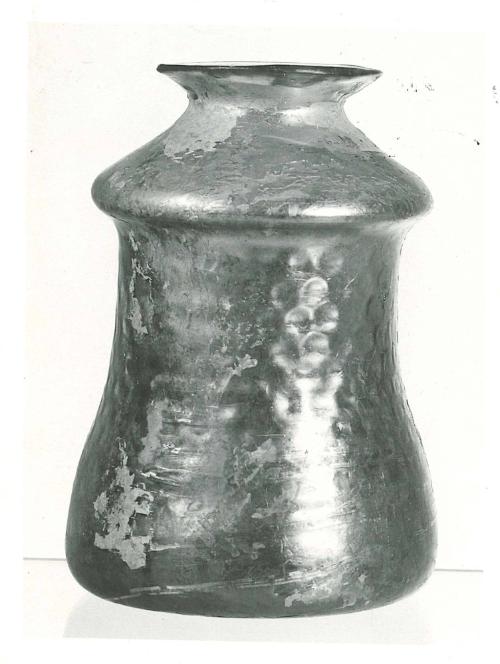

Jar with Honeycomb Pattern
Place of OriginReportedly from Iran (Gorgan)
Date10th-12th century
DimensionsH: 5 7/16 in. (13.8 cm); Rim Diam: 2 5/16 in. (5.9 cm); Body Diam: 3 3/4 in. (9.6 cm)
MediumExpanded mold-blown and tooled glass.
ClassificationGlass
Credit LineGift of Edward Drummond Libbey
Object number
1953.55
Not on View
DescriptionA small jar or vase of transparent golden-amber glass. The vessel features a flared rim, a constricted neck, and a globular body that tapers slightly towards the base. The body is decorated with a faint "honeycomb" pattern of concave circles, created by blowing the parison into a patterned mold before expansion. The surface exhibits light iridescence and pitting consistent with archaeological burial.
Label TextThis golden-amber jar features a delicate "honeycomb" pattern, a design achieved by blowing hot glass into a mold and then expanding it. This technique was popular across the Middle East in the 10th and 11th centuries, allowing for the creation of textured surfaces that played with light. While the jar was originally reported to have been found in the Iranian city of Gorgan—a major center for glass and ceramic arts—the style is also closely linked to workshops in Syria, illustrating the vibrant trade and shared artistic tastes of the medieval Islamic world.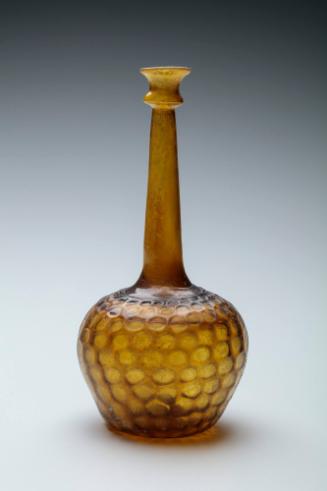
Medieval Islamic period, about 12th-13th century

9th-11th century

about 1230
400-300 BCE

about 480 BCE
Late 8th or 7th century BCE

First half of the 1st century CE
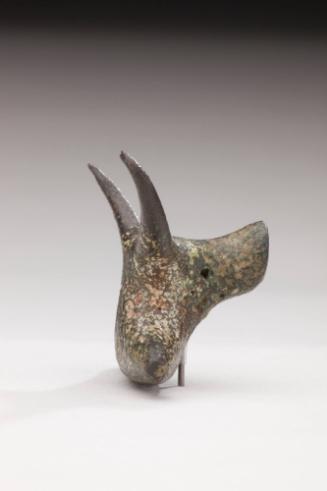
about 2400 - 2000 BCE
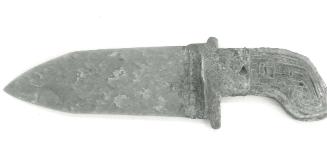
Shang Dynasty (1766-1045 BCE)
4th century
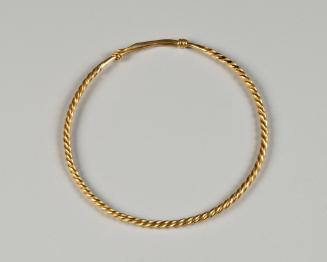
Roman Period, about 50 CE

8th-10th century

Membership
Become a TMA member today
Support TMA
Help support the TMA mission