

Bottle with Honeycomb Pattern
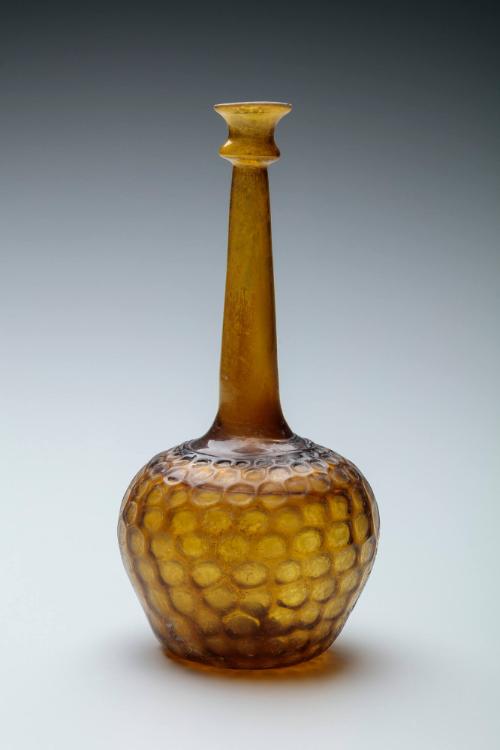

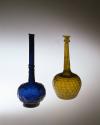
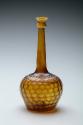
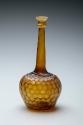
Bottle with Honeycomb Pattern
Place of OriginIran, Golestan, found at Abadan Tappeh
DateMedieval Islamic period, about 12th-13th century
DimensionsH: 8 7/8 in. (22.5 cm); Diam: 4 1/8 in. (10.5 cm)
MediumBrown glass; blown in a single-part mold (post technique), tooled on the pontil.
ClassificationGlass
Credit LinePurchased with funds from the Libbey Endowment, Gift of Edward Drummond Libbey
Object number
1971.162
Not on View
DescriptionA globular bottle of deep amber glass featuring a spherical body and a tall, tapering neck. The body is decorated with a continuous honeycomb or hexagonal network pattern, achieved by blowing the glass parison into a dip-mold and subsequently expanding it to soften the ridges. The neck is smooth and tubular, terminating in a flared mouth with a folded rim. Three distinct applied glass threads ring the base of the neck, providing a transition between the shoulder and the vertical shaft. The base features a high kick (punt mark), indicating the use of a pontil rod during finishing.
Label TextThis amber bottle glows with a "honeycomb" pattern—a design that mimics the expensive cut-glass facets of earlier eras but was created here using a clever, time-saving technique. The glassmaker blew a bubble of hot glass into a patterned mold and then inflated it further, expanding the mesh into soft, rhythmic hexagons. Found in the Gorgan region of northeastern Iran, a major hub of the Silk Road, vessels like this were likely used as qumqums (sprinklers) to dispense rosewater or perfume during social gatherings. The long, tapered neck allowed for a controlled pour, while the applied threads at the shoulder added grip and visual grace. This bottle is attributed by the dealer to the site of Abadan Tappeh, a location that has yielded distinctively high-quality glassware from the Seljuk era. As a qumqum (sprinkler), it likely held rosewater.Published ReferencesPage, Jutta-Annette, The Art of Glass: Toledo Museum of Art, Toledo, Ohio, Toledo Museum of Art, 2006, p. 64, repr. (col.) fig. 24B, p. 65.Comparative ReferencesCf. Wilkinson, Tony J., Rekavandi, Hamid Omrani, Hopper, Kristen, Priestman, Seth, Roustaei, Kourosh, and Galiatsatos, Nikolaos, The Landscapes of the Gorgān Wall, in Sauer, Eberhard W., Rekavandi, Hamid Omrani, Wilkinson, Tony J., et al., Persia’s Imperial Power in Late Antiquity: The Great Wall of Gorgan and Frontier Landscapes of Sasanian Iran, Oxford, Oxbow Books, 2013, p. 117, nos. GWS-20 and GWS-21.
10th-12th century
1st-2nd century CE




Membership
Become a TMA member today
Support TMA
Help support the TMA mission