

Beaker with Birds and Arabic Inscription
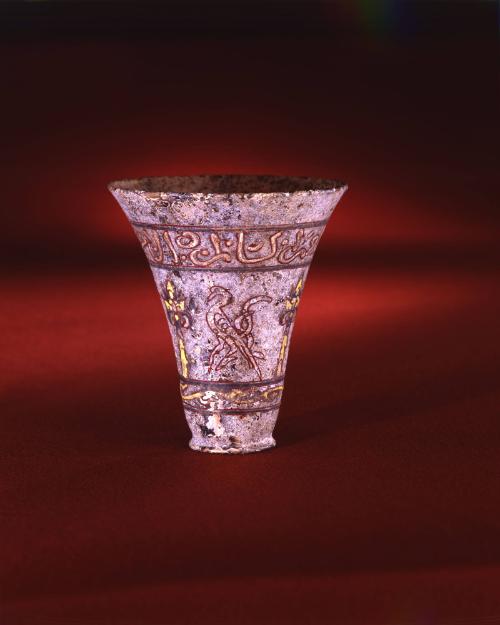

Beaker with Birds and Arabic Inscription
Place of OriginSyria
Dateabout 1230
DimensionsH: 5 in. (12.7 cm)
MediumBlown glass, with enameled and gilded decoration.
ClassificationGlass
Credit LinePurchased with funds from the Libbey Endowment, Gift of Edward Drummond Libbey
Object number
1951.279
Not on View
DescriptionA colorless, bubble-blown glass beaker featuring a flaring rim and a slightly bulbous body that tapers to a foot. The surface exhibits pitting and iridescence consistent with archaeological glass. The decoration is executed in polychrome enamels (red, white, yellow, black) and gold. The decorative scheme is divided into zones: an upper band containing a calligraphic inscription, a central field featuring two birds flanking a stylized palm leaf or vegetal motif, and a lower band of scrolling tendrils.
Label TextThis delicate beaker represents the "Golden Age" of Islamic glassmaking. Created in Syria during the 13th century, it would have been used at elite social gatherings, possibly for drinking wine. The band of Arabic calligraphy at the rim offers a toast to the drinker: "Everlasting glory, good health, eternal peace." Below, two birds flank a stylized palm tree—an ancient symbol often associated with the "Tree of Life."Published ReferencesSarre, Bulletin of the Bachstitz Gallery, September 1924, p. 23.
Gallois, Cat. Tentoonstellung's Gravenhage, 1927, no. 131, p. 31, repr.
Lamm, C. J., Mittelalterliche Gläser etc., vol. I, 1930, p. 276, repr. II, pl. 96, no. 8.
"The Islamic Collection," Bulletin of the Bachstitz Gallery, 1930, pp. 34-35, repr.
Galerie Bachstitz, II, no. 229, p. 76, pl. 99.
Exhibition HistoryHouston, Museum of Natural Science; San Francisco, California Academy of Sciences; Pittsburgh, Carnegie Institute; Washington, National Museum of Natural History; Brooklyn Museum, The Heritage of Islam, 1982-1984.
2nd century CE

10th-12th century

about 100 BCE

10th century

Late 13th century
about 1350-1360
about 350-325 BCE

about 15 BCE - 25 CE (Roman, Augustan)

about 15 BCE - 25 CE (Roman, Augustan)


Membership
Become a TMA member today
Support TMA
Help support the TMA mission