

Bowl with Zodiac Signs
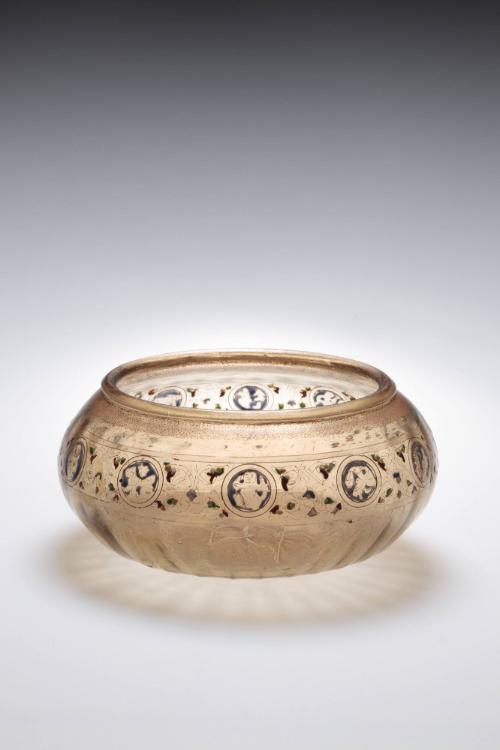


Bowl with Zodiac Signs
Place of OriginSyria or Egypt; reportedly excavated in Hamadan, Iran
DateLate 13th century
DimensionsOverall (H x Dia. x Rim Dia. ): 3 1/2 × 9 1/4 × 7 1/8 in. (8.9 × 23.5 × 18.1 cm)
MediumBlown glass, enameled and gilded.
ClassificationGlass
Credit LinePurchased with funds from the Libbey Endowment, Gift of Edward Drummond Libbey
Object number
1941.37
Not on View
DescriptionHoney-colored blown glass bowl with a squat, rounded body and a wide, slightly inverted rim. The vessel features a kick base with a visible pontil mark. The surface is extensively decorated with polychrome enamels in red, blue, green, yellow, and white, alongside heavy gilding. The primary exterior register displays circular medallions containing figures representing signs of the Zodiac, set against a background of scrolling arabesques and floral motifs. A delicate, lace-like band of gilded decoration encircles the rim.
Label TextThe design of this rare glass Zodiac bowl reflects the Islamic belief in the influence of celestial events on human affairs. The study of the movement of planets and stars was gradually shifting from the hard-science realm of astronomy toward the popular, often mystical terrain of astrology that viewed the universe as a circles-within-circles hierarchy. In Islamic decorative art from this period, the central motif is commonly the sun – here represented by a hexagonal star - rather than the earth. Although astrology was considered a branch of astronomy because it required an understanding of the movement of the planets and the ability to calculate their positions in the future, this view was controversial and not universally accepted as a scientific or ethical practice. Objects with astrological decoration were thought to have talismanic powers and protected the owner from sickness, bad luck, or defeat.
According to the dealer Arthur Upham Pope, this bowl was found during dealer Benjamin Mahboubian (1869-1969)'s 1908 excavations in Hamadan, Iran.
Published ReferencesAtil, Esin, Renaissance of Islam: Art of the Mamluks, Washington DC, Smithsonian Institution Press, 1981, no. 48, p. 129, repr. (col.).Ward, Rachel (ed.), Gilded and Enamelled Glass from the Middle East: Origins, Innovations and Influences, London, Trustees of the British Museum / British Museum Press, 1998, p. 22.
Exhibition HistoryWashington, National Museum of Natural History; Minneapolis Institute of Art: N.Y., Metropolitan; Cincinnati; Detroit; Phoenix; Hartford, Wadsworth Atheneum, Renaissance of Islam: Art of the Mamluks, Washington, 1981, no. 48, p. 129, repr. (col.).
late 13th century
about 1350-1360

about 1230
150-100 BCE
Mid-14th century
about 1500



Membership
Become a TMA member today
Support TMA
Help support the TMA mission