

Jade Dagger-Axe (Ge) with Bronze Haft

Jade Dagger-Axe (Ge) with Bronze Haft
Place of OriginChina, reportedly from Anyang, Henan Province
DateShang Dynasty (1766-1045 BCE)
DimensionsL: 10 in. (25.4 cm)
MediumJade (nephrite) and bronze
ClassificationMetalwork
Credit LineGift of Thomas T. Solley
Object number
1991.50
Not on View
DescriptionA ceremonial weapon consisting of a beveled jade blade mounted into a cast bronze handle. The jade blade is flat and pointed with a central ridge, rendered in a translucent, mottled icy gray-green stone. The bronze handle is flat with a curved butt and features raised linear decoration creating cloisons (cells) in the shape of stylized kui dragons, which originally held inlay. The bronze surface exhibits green encrustation and corrosion consistent with burial.
Label TextThis ceremonial blade, known as a ge (dagger-axe), combines the supreme hardness of jade with the technological prowess of cast bronze. While the ge was the primary weapon of war for Shang soldiers, this example was never intended for battle. Its brittle jade blade would have shattered on impact. Instead, it served as a ritual object—a symbol of military power and elite status buried with a high-ranking aristocrat to serve them in the afterlife. The bronze handle features stylized dragon designs that originally held turquoise inlays, a luxurious embellishment typical of the royal workshops at the Shang capital of Anyang.Comparative ReferencesSee also Lee, Sherman, A History of Far Eastern Art, New York, Harry N. Abrams, 1982, p. 31. cf. Bagley, Robert W., Shang, Ritual Bronzes in the Arthur M. Sackler Collections, Harvard University Press, 1987, pp. 75-77.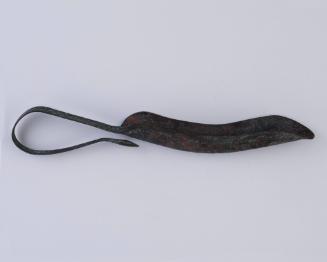
400-300 BCE
12th-11th century BCE
about 2400 - 2000 BCE

Membership
Become a TMA member today
Support TMA
Help support the TMA mission