

Wheel-Cut Qumqum (Perfume Sprinkler)
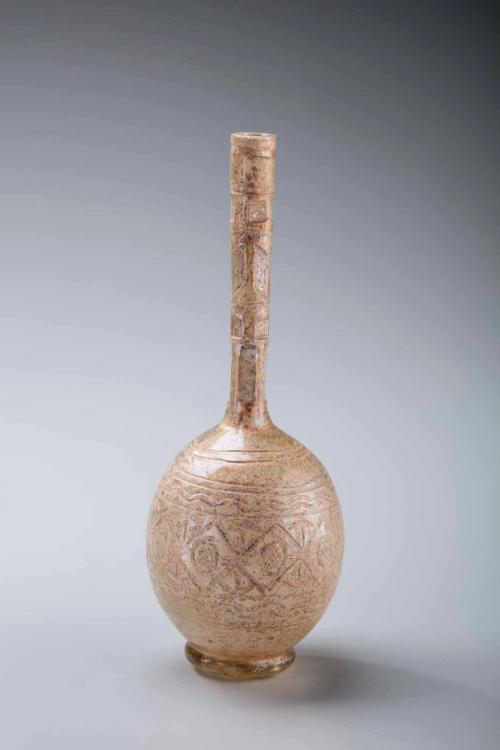

Wheel-Cut Qumqum (Perfume Sprinkler)
Place of OriginIran, reportedly from Gorgan
Date9th-10th century
DimensionsH: 8 7/8 in. (22.5 cm)
MediumColorless glass; blown and wheel-cut
ClassificationGlass
Credit LinePurchased with funds from the Libbey Endowment, Gift of Edward Drummond Libbey
Object number
1947.4
Not on View
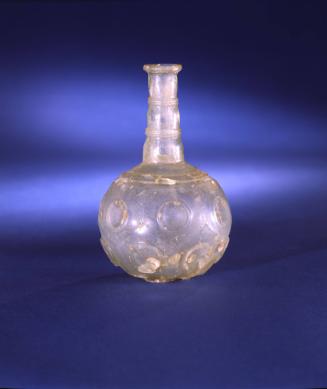
DescriptionA vessel of colorless glass featuring a globular body and a tall, narrow neck that flares slightly at the rim. The decoration is achieved through deep wheel-cutting ("cold-cutting"). The neck is cut with faceted panels, creating a hexagonal or octagonal cross-section that emphasizes the refractive quality of the glass. The shoulder is defined by a raised, horizontal ridge. The body features a broad frieze of relief-cut geometric patterns, typically interlocking ovals, lozenges, or honeycomb motifs, executed with thick, varying depth of cut.
Label TextThis bottle represents the zenith of the lapidary style in early Islamic glassmaking. Following the traditions of the Sasanian Empire (224–651 CE), Islamic glassmakers in the 9th and 10th centuries perfected the art of "cold-cutting," treating blown glass vessels as if they were hardstones. The vessel form, with its globular body and long, narrow neck, is identified as a qumqum, or sprinkler, used for dispensing fragrances like rosewater.Published ReferencesRiefstahl, Rudolf M., "Ancient and Near Eastern Glass," Toledo Museum News, New Series, Vol. 4, No. 2, Spring 1961, p. 42.
Toledo Museum of Art, Art in Glass: A Guide to the Glass Collections, Toledo, 1969, p. 38.
Comparative ReferencesCf. Clairmont, Christoph, "Some Islamic Glass in the Metropolitan Museum," Islamic Art in the Metropolitan Museum of Art, New York, 1972, pp. 146-147.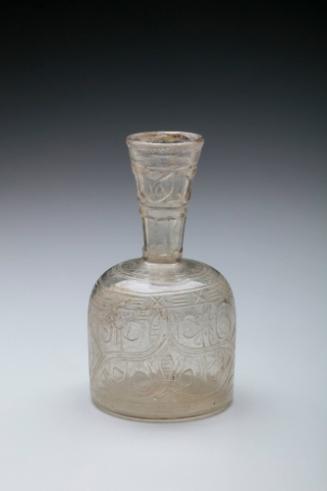
9th-10th century
11th century

10th century

Probably mid-1st century, about 40-70
Unidentified, Gorgoneion Group
about 560 BCE
late 13th century

1st-2nd century CE
Late 4th - early 5th century CE
Early to Late 15th century
Hyksos, 17th-16th century BCE
7th-8th century

Membership
Become a TMA member today
Support TMA
Help support the TMA mission