

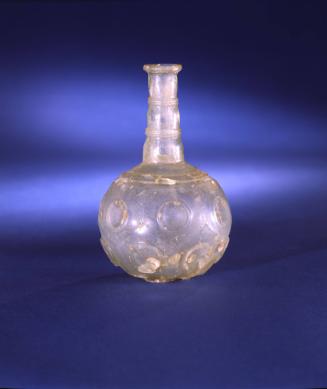
Wheel-Cut Bottle
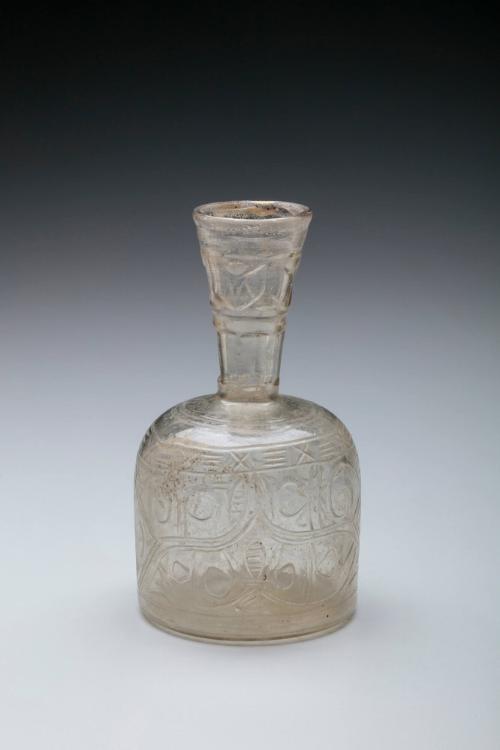

Wheel-Cut Bottle
Place of OriginIran, reportedly from Gorgan
Date9th-10th century
Dimensions5 7/8 × 3 1/8 in. (14.9 × 7.9 cm)
MediumColorless glass, blown and wheel-cut
ClassificationGlass
Credit LinePurchased with funds from the Libbey Endowment, Gift of Edward Drummond Libbey
Object number
1947.5
Not on View
DescriptionA small, colorless glass bottle featuring a cylindrical body with a flat base, a sloping shoulder, and a tall, flaring neck. The thick walls are deeply carved in the beveled style (slant-cut) with abstract, stylized vegetal and geometric motifs. The body decoration consists of rhythmic, curvilinear scrolls and palmettes set within geometric lozenges or cartouches, created by wheel-cutting the glass at an angle to form ridges without a flat background plane. The neck features faceted or horizontal cut bands.
Label TextThis bottle is a superb example of the "beveled" or "slant-cut" style, a technique that revolutionized Islamic glass and stucco carving in the 9th century. Instead of cutting down to a flat background, the glass cutter ground the surface at angles to create smooth, curved ridges that catch the light. The abstract design—a mesmerizing mix of scrolling vines and geometric shapes—reflects the artistic tastes of the Abbasid caliphates in Samarra (Iraq) and Nishapur (Iran). Small, sturdy bottles like this were likely used to hold expensive perfumes or oils, their thick walls protecting the precious contents inside.Published ReferencesRiefstahl, Rudolf M., "Ancient and Near Eastern Glass," Toledo Museum News, New Series, Vol. 4, No. 2, Spring 1961, p. 42.
Toledo Museum of Art, Art in Glass: A Guide to the Glass Collections, Toledo, 1969, p. 38.

10th century
11th century

9th-10th century

9th-10th century

7th-8th century
about 700 BCE


18th Dynasty (1550-1292 BCE), about 1390 BCE

Membership
Become a TMA member today
Support TMA
Help support the TMA mission