

Inverted Conical Jug

Inverted Conical Jug
Place of OriginRoman Empire, probably Palestine
DateProbably 6th to early 7th century
DimensionsH: 3 7/16 in. (8.7 cm); Rim Diam: 1 3/8 in. (3.5 cm); Body Diam: 1 7/8 in. (4.7 cm)
MediumGlass; mold-blown and tooled.
ClassificationGlass
Credit LineGift of Edward Drummond Libbey
Object number
1923.1336
Not on View
DescriptionThe jug is made of transparent moderate blue-green glass (near 5 BG 4/6) with a similarly colored coil and handle. The thin glass body shows numerous bubbles and blowing spirals. The neck and mouth are free-blown, while the body was probably blown into a one-part patterned mold and then slightly expanded. A pontil mark, approximately 1.2 cm in diameter, is visible. Excess glass at the tip of the handle was folded back against the top of the handle. The rim is folded outward, upward, and inward to form a circular mouth with a tubular neck that tapers upward. The inverted conical body has a base with a low tooled kick. A curved coil handle is attached to the shoulder and rim and folded down to form a closed loop against the mouth. A coil was trailed from left to right around the middle of the neck. The body has a mold-blown design of seven alternating rows of sunken hexagons. The underside of the base features nine radial indentations.
Published ReferencesAuth, Susan H., Ancient Glass at the Newark Museum, Newark, NJ, 1976, p. 86, cited at no. 91.
Stern, E. Marianne, Roman Mold-blown Glass: The First through Sixth Centuries, Rome, "L'Erma" di Bretschneider, 1995, p. 265, no. 188.
Probably 6th to early 7th century

6th to early 7th century

6th to early 7th century

Late 4th to mid-5th century
4th or early 5th century CE
6th to early 7th century
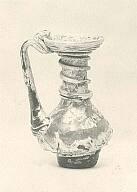
Probably second half of 4th to early 5th century CE
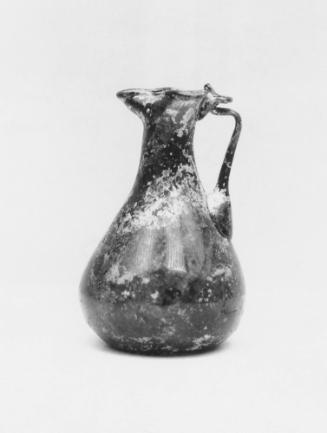
2nd-4th century CE

Membership
Become a TMA member today
Support TMA
Help support the TMA mission