

Statuette of the Goddess Bhudevi (Lakshmi)
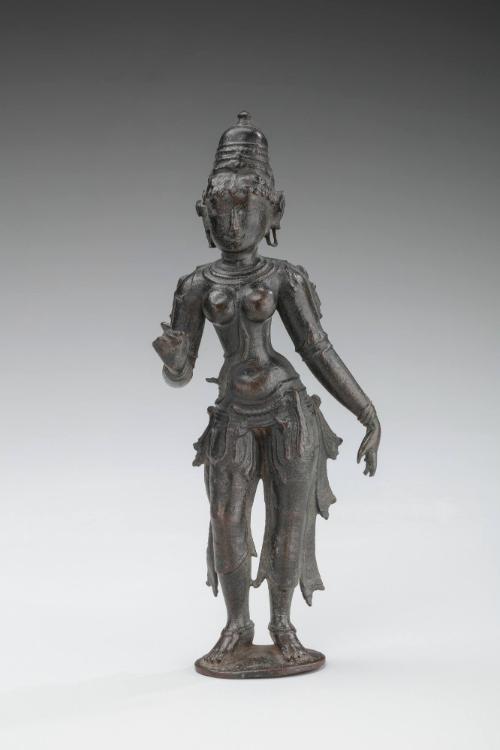




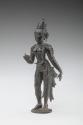
Statuette of the Goddess Bhudevi (Lakshmi)
Place of OriginSouth India
DateChola Dynasty (850-1310), about 950
DimensionsH: 6 3/8 in. (16.2 cm); W: 2 7/16 in. (6.2 cm)
MediumBronze
ClassificationSculpture
Credit LineGift of Thomas T. Solley
Object number
1991.53
Not on View
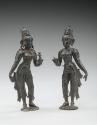
DescriptionTwo small, standing copper-alloy figures cast via the lost-wax technique. Both figures stand in a tribhanga (triple-bend) posture on circular lotus pedestals, with their heads tilted slightly and hips swayed. Both wear high, conical karanda mukuta headdresses, large circular ear ornaments, heavy necklaces, armbands, bracelets, and anklets. They wear diaphanous lower garments secured by elaborate girdles with hanging sashes. One figure (1991.53) is distinguished by a kuchabandha (breast band) tied across the chest. The other figure (1991.52) is bare-chested and holds the bud of a lotus or water lily in the right hand; the left arm hangs gracefully by the hip (lola hasta). The surfaces show a dark, brownish-black patina.
Label TextThese elegant bronze figures represent the two consorts of the Hindu god Vishnu: Sridevi (the goddess of wealth, also known as Lakshmi) and Bhudevi (the earth goddess). In a traditional temple setting or domestic shrine, these goddesses would stand to the left and right of a central image of Vishnu, completing a triad that symbolizes the deity's preservation of the universe and earthly prosperity. While the two figures are stylistically similar—featuring the graceful tribhanga (triple-bent) pose and high conical headdresses typical of Chola-period art—they can be distinguished by specific details. Sridevi (1991.53) wears a kuchabandha (breast band), a symbol of her status as the primary consort. Bhudevi (1991.52) is identified by the lotus bud held in her right hand. These small-scale works were likely created for a private household shrine rather than a large public temple.Comparative ReferencesSee also Roland, Benjamin, A History of Indian Art and Architecture, London, 1953, pp. 328-332.
cf. Chandra, Pramod, The Sculpture of India, Washington, D.C., 1985, pp. 184, 188.
cf. Harle, J.C., The Art and Architecture of the Indian Subcontinent, London, 1986, pp. 304-310.
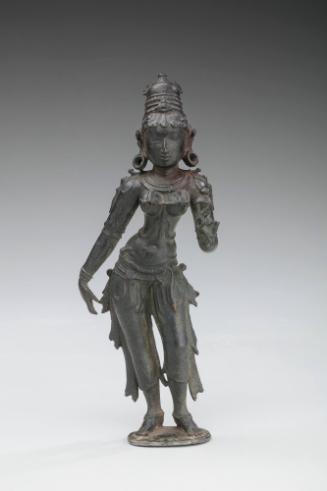
Chola Dynasty (850-1310), about 950

Gupta Period (320-647), about 600

2nd-1st century BCE


Before 1880
early 12th century
Ptolemaic Period (332–30 BCE), about 200–50 BCE

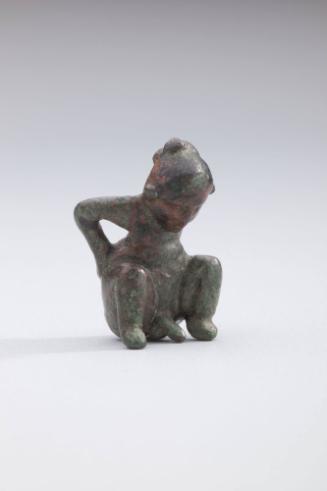
about 1st century CE

about 230 BCE- 220 CE
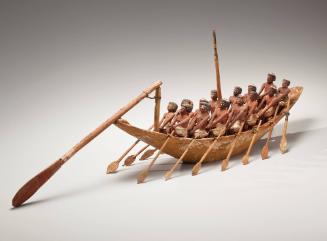
11th–12th Dynasties (2130–1802 BCE)

Membership
Become a TMA member today
Support TMA
Help support the TMA mission