

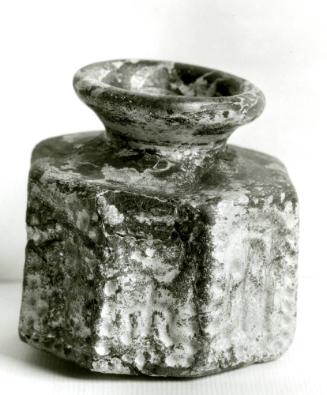
Square Bottle with Relief of Mercury and Trade Inscription

Square Bottle with Relief of Mercury and Trade Inscription
Place of Originlikely Gaul, Rhineland, or Northern Italy
Date1st-2nd century CE
DimensionsH: 8 in. (19.60 cm); Rim Diam: 2 1/8 in. (5.32 cm); Base Depth: 1 1/4 in. (3.10 cm); Base W: 1 1/4 in. (3.10 cm); Shoulder W: 1 1/2 in. (3.89 cm)
MediumGlass; mold-blown natural green glass.
ClassificationGlass
Credit LineMr. and Mrs. Rabi Raffi Soleimani
Object number
1987.216
Not on View
DescriptionA tall, square-bodied flask made of transparent to translucent light olive-green glass. The vessel features a wide, horizontal rim folded outward, downward, upward, and inward to form a flattened collar. The cylindrical neck is tall and concave, widening slightly as it joins the shoulder. The shoulder is horizontal with rounded corners, transitioning sharply into the four vertical walls of the square body. The body tapers slightly downward toward the base. The underside of the base features a high-relief, mold-blown design depicting the god Mercury standing in three-quarter view to the left. He wears a short tunic and a cloak draped over his left shoulder. His right hand is outstretched, holding a triangular attribute (possibly a purse or caduceus). The figure is surrounded by the Latin letters G, F, I, and H, positioned in the corners clockwise from the top left. The glass contains small spherical bubbles in the body and elongated bubbles in the neck. No pontil mark is visible.
Label TextThis vessel is a representative example of the "Mercury bottle," a specific variant of the ubiquitous Roman square bottle (Isings Form 84). Manufactured widely in the Western Roman provinces (Gaul, the Rhineland, and Northern Italy) during the 1st and 2nd centuries CE, these vessels were the primary industrial containers for the transport and storage of liquids. The bottle was formed by blowing a paraison of glass into a square-sectioned body mold, while the neck and rim were free-blown and tooled. The distinctive feature of this sub-type is the base stamp, which features the figure of Mercury (Greek: Hermes) in relief. As the patron deity of mercatores (merchants), Mercury’s image on a commercial vessel is interpreted as both a sign of good fortune for the transaction and an apotropaic device protecting the shipment. The accompanying letters G F I H, positioned in the corners, likely represent a workshop signature (tria nomina or similar formula), though the specific manufacturer remains unidentified.Published ReferencesStern, E. Marianne, "Roman Glassblowing in a Cultural Context," American Journal of Archaeology, vol. 103, no. 3, July 1999, p. 467, fig. 27, p. 468.Exhibition HistoryToledo Museum of Art, Out of Sight, June 18-Aug. 29, 2010 (no cat.).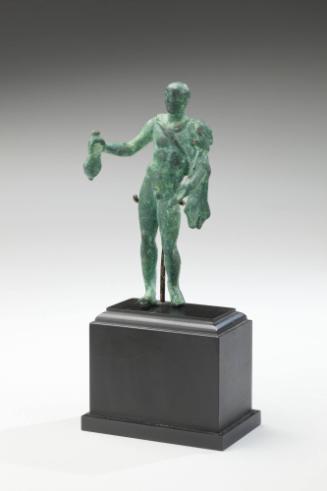
1st to 3rd century CE
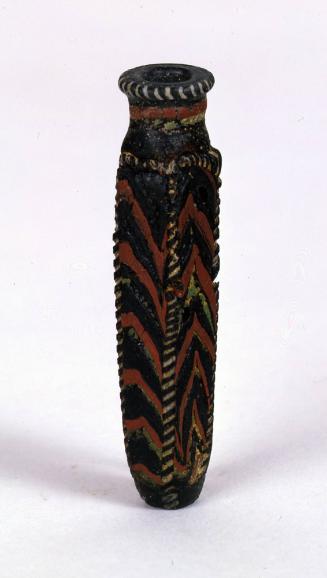
5th-4th century BCE, possibly later
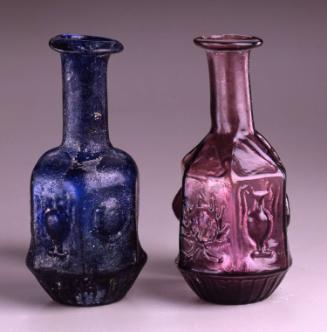
Second quarter to mid-1st century CE

6th to early 7th century

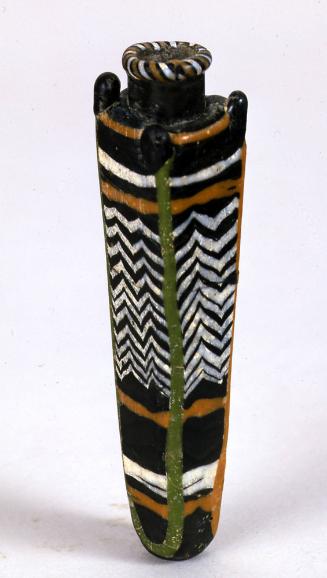
5th-4th century BCE


about 578-629

3rd-4th century CE

Membership
Become a TMA member today
Support TMA
Help support the TMA mission