

Square-Sectioned Kohl Tube
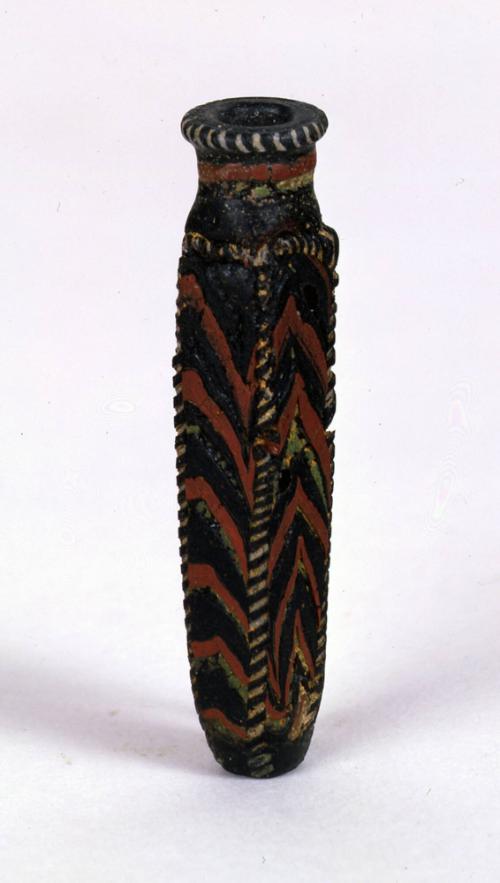


Square-Sectioned Kohl Tube
Place of OriginLikely Iran (Northwestern), reportedly from the Ghalekuti region
Date5th-4th century BCE, possibly later
DimensionsH: 3 1/8 in. (7.9 cm); Diam (lip): 5/8 in. (1.6 cm); Diam (body): 9/16 in. (1.4 cm)
MediumRod-formed; applied marvered, partly marvered, and unmarvered threads.
ClassificationGlass
Credit LineGift of Duane Wilder
Object number
1980.1002
Not on View
DescriptionA tall, narrow cosmetic tube with a square body in horizontal section, tapering slightly toward a flattened base. The vessel features a short, cylindrical neck and a thick, horizontal rim disc. The body is opaque black glass, decorated with applied threads of opaque jasper red and yellowish-green glass. These threads are marvered smooth and tooled into a rhythmic feather or chevron pattern that covers the four flat sides. The vertical corners of the body are accentuated by applied twisted cables of black and white glass, which also encircle the rim and upper shoulder. The interior is cylindrical, formed around a metal rod.
Label TextThis slender, square-sided tube was a luxury accessory for the ancient elite, designed to hold kohl—a black cosmetic powder used to darken the eyelids and protect the eyes from the sun’s glare. Unlike typical pottery containers, this vessel is made of brightly colored glass formed around a metal rod, a technique that allowed for a precise, narrow interior. The vibrant "feather" pattern was created by winding threads of jasper red and yellow-green glass around the hot black body and combing them with a tool. This specific style of glass is associated with the Achaemenid Persian Empire, which ruled a vast territory from India to Greece. Similar tubes have been found in the tombs of wealthy individuals in northwestern Iran, often accompanied by gold jewelry.Published References"Recent Important Acquisitions," Journal of Glass Studies 23, 1981, p. 91, fig. 3.
Grose, David F., Early Ancient Glass: Core-Formed, Rod-Formed, and Cast Vessels and Objects from the Late Bronze Age to the Early Roman Empire, 1600 B.C. to A.D. 50, New York, Hudson Hills Press in association with the Toledo Museum of Art, 1989, Cat. No. 32, p. 86, Repr. (col.) p. 69.
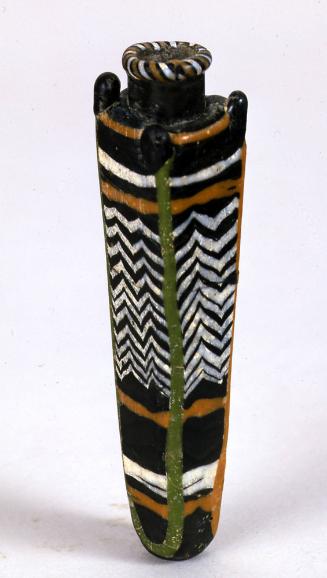
5th-4th century BCE

Late 18th or 19th Century (1400-1225 BCE)

Probably 6th Century BCE
Late 1st century BCE to early 1st century CE
Late 1st century BCE to early 1st century CE
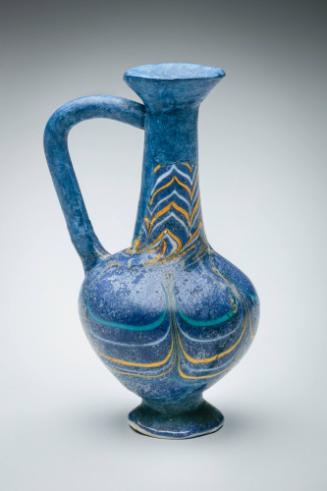
18th Dynasty (1550-1292 BCE), about 1400-1350 BCE
Late 1st century BCE to early 1st century CE
Late 1st century BCE to early 1st century CE
Late 1st century BCE to early 1st century CE
Late 1st century BCE to early 1st century CE
Late 6th through 5th century BCE

Membership
Become a TMA member today
Support TMA
Help support the TMA mission