

Statuette of a Woman Holding a Phiale
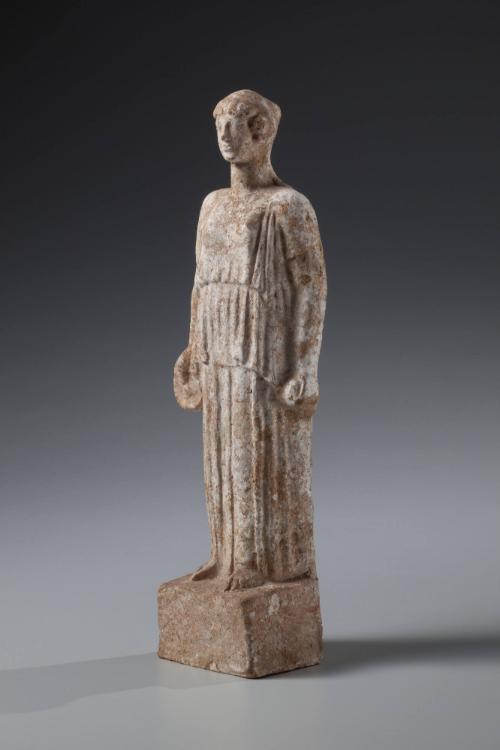


Statuette of a Woman Holding a Phiale
Place of OriginGreece, Boeotia or possibly Turkey
Datemid-5th century BCE
DimensionsH: 12 1/8 in. (30.8 cm); W: 3 7/8 in. (9.9 cm); Depth: 2 7/8 in. (7.3 cm)
MediumEarthenware; molded and hand-finished earthenware, pale orange clay with white slip and traces of pink and red polychromy.
ClassificationSculpture
Credit LineGift of the Popplestone Family
Object number
2006.84
On View
Toledo Museum of Art (2445 Monroe Street), Gallery, 02, Classic
DescriptionA hollow, mold-made terracotta statuette of a standing female figure facing forward on a low, integral rectangular base. She stands in a static, frontal pose reminiscent of the Severe Style. She wears a peplos with a long, heavy overfold (apoptygma) that falls in vertical, flute-like folds over her torso and legs, obscuring most of her form. Her hair is swept up and entirely enclosed within a sakkos (scarf) or snood. In her right hand, extended slightly forward, she holds a phiale (shallow offering bowl). Her left arm hangs at her side, holding a small round fruit (possibly a pomegranate) or offering against her thigh. The clay is pale orange, coated with a white slip. Extensive traces of pink pigment remain on the drapery, with dull red on the lips and details. The back is unmodeled and smooth, featuring a vent hole. The interior of the base bears pencil markings ("34").
Label TextThe figure is a peplophoros, depicting a standing woman clad in a heavy peplos with a long apoptygma (overfold) that reaches her thighs. The drapery is rendered with thick, vertical folds that emphasize the columnar stability of the figure, a hallmark of the Classical "Severe Style" or Early Classical period. Her hair is entirely concealed within a sakkos, focusing attention on the smooth, idealized planes of her face. She holds a phiale mesomphalos in her extended right hand and a spherical object, likely a pomegranate or apple, in her lowered left hand—attributes standard for votive figures dedicated to female deities such as Demeter, Persephone, or Aphrodite.Published ReferencesFragments of Time XXXV (2003) no. 23.Comparative ReferencesCf. Louvre CA 1263 (Boeotia)
about 200 CE

100 BCE to 150 CE


about 300 BCE
26th Dynasty (664–525 BCE), about 650 BCE

about 300 BCE

3rd-2nd century BCE
![Sans titre [Untitled]](/internal/media/dispatcher/81737/thumbnail)
about 1956-1959 (printed 2016)
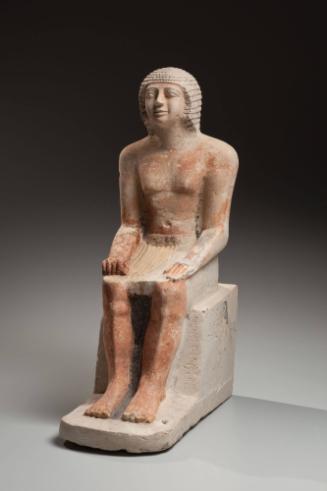
6th Dynasty (2345-2181 BCE)

Membership
Become a TMA member today
Support TMA
Help support the TMA mission