

Woman with Strap Handle (from a Canosan Askos)
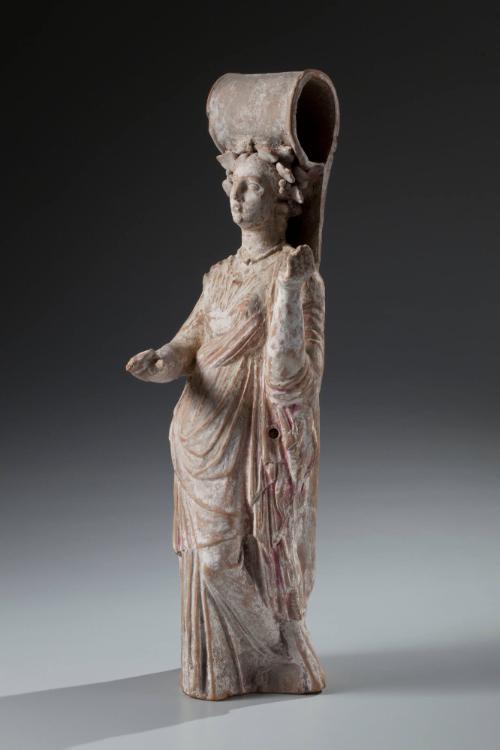


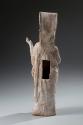
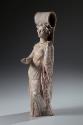
Woman with Strap Handle (from a Canosan Askos)
Place of OriginItaly, attributed to Canosa di Puglia (Apulia)
Dateabout 300 BCE
DimensionsH: 20 3/4 in. (52.7 cm); W: 7 1/2 in. (19.1 cm); Depth: 7 7/8 in. (20.0 cm)
MediumEarthenware with polychrome pigment over white slip
ClassificationSculpture
Credit LineGift of the Popplestone Family
Object number
2006.83
Not on View
DescriptionA mold-made terracotta figure of a standing woman, serving as a decorative vertical handle or false neck for a large vessel. She stands with her weight on her right leg, wearing a chiton and a himation wrapped around her waist and left arm. Her skin is white, with traces of pink (madder) on her drapery and green on the floral wreath in her hair. Her arms are bent at the elbow and extended forward; the hands are pierced with holes originally intended to hold separately attached attributes (now missing). A broad, flat strap handle rises from her back, connecting to the top of her head. The reverse of the figure features a large rectangular firing vent. The surface is fragile, with polychromy applied after firing (tempera technique).
Label TextThis colorful figure was not a standalone statue, but a decorative handle attached to a monumental vase, likely an askos (a wine vessel) placed in a tomb. Created in Canosa, a center for flamboyant Hellenistic pottery, she was originally painted in bright pinks and greens over a white slip, mimicking the appearance of expensive marble or wall painting. The holes in her hands suggest she once held tiny attributes—perhaps a lyre, mirror, or floral sprigs—made of wood or metal. Her festive wreath and pose suggest she is a Nymph or Maenad, a follower of Dionysos, whose presence in the tomb promised a joyful afterlife.Published ReferencesExhibition of Greek and Etruscan Antiquities, Tokyo, 1974, pl. 72.
Simon, Erika, The Kurashiki Ninagawa Museum, Greek, Etruscan and Roman Antiquities. Mainz, Verlag Philipp von Zabern, 1982, 208-209, no 141.
Antiquities, Christie's, New York, 12 December 2002, p. 40, lot 58.
Eisenberg, Jerome M., "Winter 2002 Antiquities Sales," MINERVA, vol. 14, no. 2 (2003) p. 42. (Note: This object is neither illustrated nor mentioned in this review, but there is a brief account of the ownership of the 112 lots sold at Christie's as probably "unpublicised long-term loans from Mr. and Mrs. Fujita" to the Kurashiki Ninagawa Museum and "all the property of the recently deceased dealer Takuhiko Fujita," who was the primary source of the Museum.)
Exhibition HistoryExhibition of Greek and Etruscan Antiquities, Tokyo, 1974, pl. 72.
325-300 BCE

3rd-2nd century BCE

about 150 CE

100 BCE to 150 CE


2nd century CE

1st-2nd century CE
1st century BCE - 3rd century CE

Membership
Become a TMA member today
Support TMA
Help support the TMA mission