

Votive Bust of a Woman, Possibly Demeter or Persephone
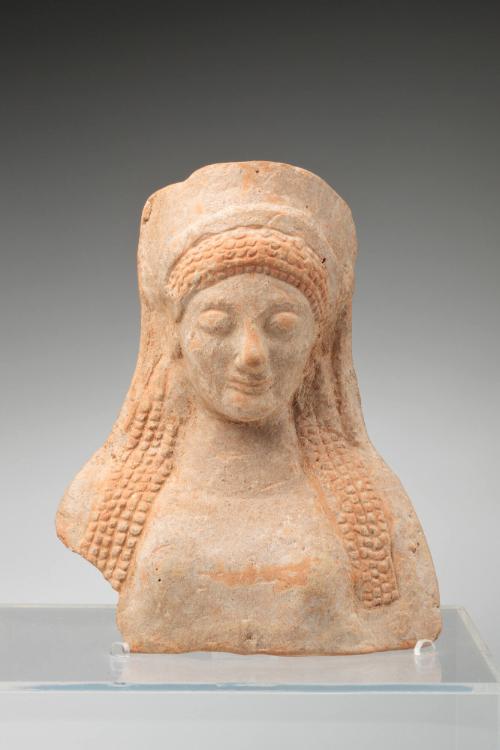


Votive Bust of a Woman, Possibly Demeter or Persephone
Place of OriginItaly, Sicily
Date500-450 BCE
Dimensions5 7/8 × 4 1/2 × 2 in. (14.9 × 11.4 × 5.1 cm)
MediumMolded terracotta with traces of red coloring
ClassificationSculpture
Object number
1962.22
On View
Toledo Museum of Art (2445 Monroe Street), Gallery, 02, Classic
DescriptionThis mold-made terracotta bust represents a female figure facing forward. She wears a high, distinct headdress (stephane or polos) from which a veil drapes down behind her ears and onto her shoulders. Her hair is arranged in stylized, beaded rows framing the forehead. The facial features exhibit characteristics of Late Archaic to Early Classical style, with almond-shaped eyes and a slight smile. The surface retains traces of original red pigment. The bust is truncated at the chest, typical of votive protomes.
Label TextThis serene terracotta head represents a type of religious offering produced in the thousands by Greek colonists in Sicily. Known as a protome, this bust likely depicts Demeter, the goddess of agriculture, or her daughter Persephone. Worshippers would purchase these mold-made figures to dedicate at sanctuaries, seeking fertility for their crops or families.
Although made in Sicily (Magna Graecia), the style is known as "Rhodian," mimicking earlier prototypes imported from the island of Rhodes. The figure wears a high headdress called a stephane and a heavy veil. Traces of red pigment suggest it was originally brightly painted, bringing the goddess to life in the flickering light of a temple.
Exhibition HistoryToledo Museum of Art, The Berlin Painter and His World: Athenian Vase Painting in the Early Fifth Century BC, July 8-October 1, 2017.Comparative ReferencesSee also Leonard von Matt, Ancient Sicily, New York, 1960, pl. 105, repr. mask of "Rhodian" type cast from ancient mold found at Acragas (Agriguntum). Large numbers of these molds have been found there.cf. Richter, G.M.A., Archaic Greek Art, New York, 1949, pp. 184-186.
cf. Richter, G.M.A., A Handbook of Greek Art, New York, pp. 216-231, esp. pp. 222-225, pl. 331.

500-480 BCE
mid-5th century BCE
26th Dynasty (664–525 BCE), about 650 BCE


2nd century BCE – 3rd century CE

Membership
Become a TMA member today
Support TMA
Help support the TMA mission