

Fragment of a Devotional Stele with a Bodhisattva
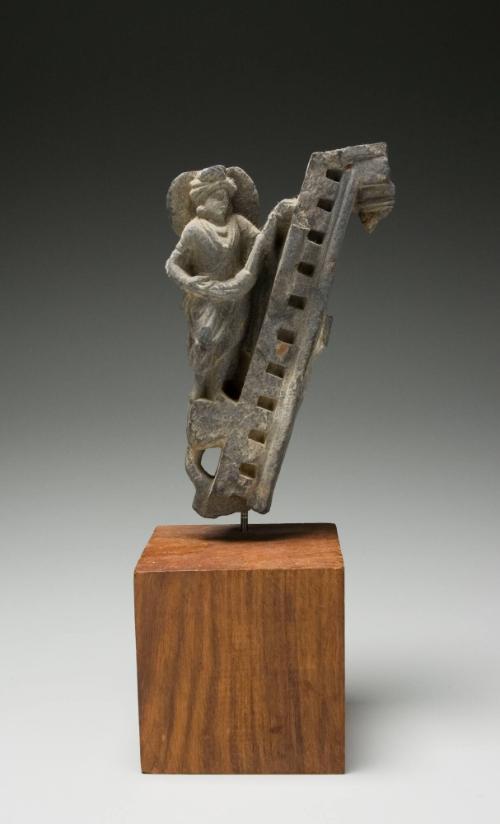


Fragment of a Devotional Stele with a Bodhisattva
Place of OriginPakistan, northern Peshawar Valley
Date3rd century, possibly early 4th century
DimensionsH (with stand): 12 in. (30.5 cm); H (without stand): 7 3/8 in. (18.7 cm); W: 3 7/8 in. (9.8 cm); Depth: 2 1/4 in. (5.7 cm)
MediumCarved schist stone with stand.
ClassificationSculpture
Credit LineGift of the Popplestone Family
Object number
2006.139
Not on View
DescriptionA relief fragment carved from gray schist, originally forming the upper right section of a stele. The fragment features a standing male figure facing left, identified as a Bodhisattva by a halo behind his head. He wears elaborate jewelry, a turban, and draped monastic robes (sanghati and paridhana). His hands are raised, holding a heavy garland. The figure stands beneath a trapezoidal border that likely framed a central niche; the inner angle of this border preserves a sculpted element resembling hanging fruit. The top edge of the fragment is finely finished. The stone surface shows natural iron inclusions and minor accretions.
Label TextThis stone fragment was once part of a large, intricate stele—a standing stone slab used for worship in a Buddhist monastery. Originally, it would have framed a central statue of the Buddha. The figure seen here is a Bodhisattva, a compassionate enlightened being, identified by his halo and rich princely jewelry. He stands in an attitude of devotion, holding a heavy garland to offer to the Buddha. Above him, a small carving of hanging fruit symbolizes spiritual abundance. The style blends local traditions with Greek and Roman artistic influences, characteristic of the multicultural Gandhara region.
3rd Century
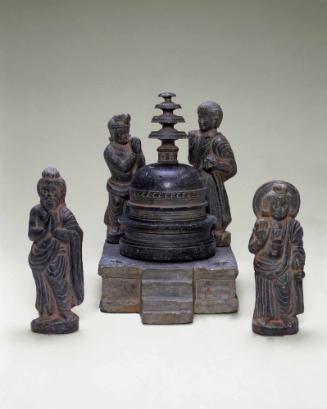
about 3rd century CE; inscription dated to earlier than 150 CE

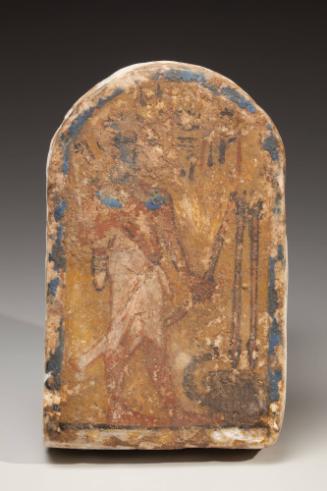
18th Dynasty (1550-1292 BCE), about 1330 BCE

6th-8th century CE

1st century BCE - 4th century CE

2nd - 3rd centuries

about 230 BCE- 220 CE

about 880 BCE

9th Dynasty (2130–2040 BCE)

Membership
Become a TMA member today
Support TMA
Help support the TMA mission