

Portable Inkwell with Handles


Portable Inkwell with Handles
Place of OriginIran, reportedly from Nishapur
Date9th-10th century
MediumMold-blown and tooled glass, with applied handles.
ClassificationGlass
Credit LineGift of Edward Drummond Libbey
Object number
1953.53
Not on View
DescriptionA small, squat vessel with a hexagonal body and a wide, cylindrical mouth. The object features a flat shoulder from which loop handles connect to the neck; two of the original four handles remain intact, while two are fractured. The surface exhibits heavy weathering and iridescence.
Label TextThis small glass vessel was once an essential tool for a scribe in medieval Iran. Originally suspended by its four loop handles (two of which are now broken), this portable inkwell allowed a writer to work while standing or traveling. In the 9th and 10th centuries, the city of Nishapur in northeastern Iran was a major center for glass production and Islamic culture. The inkwell's hexagonal body was blown into a mold, a technique that allowed for efficient production of durable, everyday objects. Its weathered, iridescent surface—a result of centuries of burial—masks the original clarity of the glass, which would have held the soot-based ink used for calligraphy.Published ReferencesHasson, Rachael, Early Islamic Glass, Jerusalem, The L.A. Mayer Memorial Institute for Islamic Art, 1979, p. 8, fig. 10; p. 35, no. 10.
Late 4th to late 5th century

4th-5th century CE

6th to early 7th century

Late 4th to late 5th century
Probably 5th century
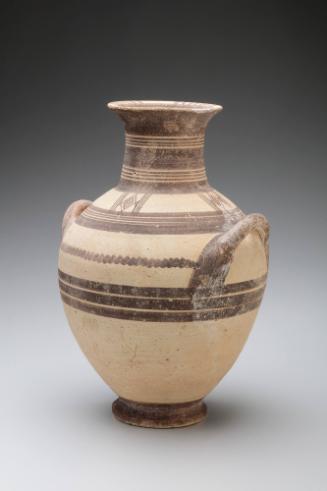
7th century BCE
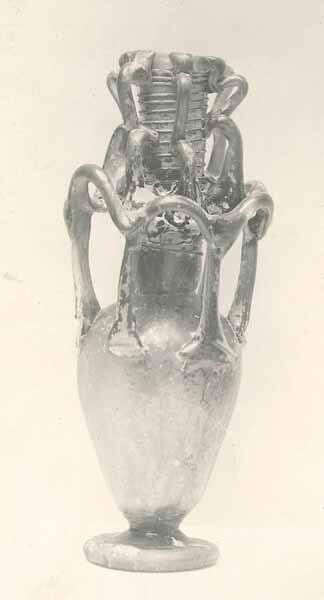
3rd-5th century CE
Possibly late 19th or early 20th century

Probably mid-4th to mid-5th century

Membership
Become a TMA member today
Support TMA
Help support the TMA mission