

Crescent-Shaped Razor with Incised Decoration
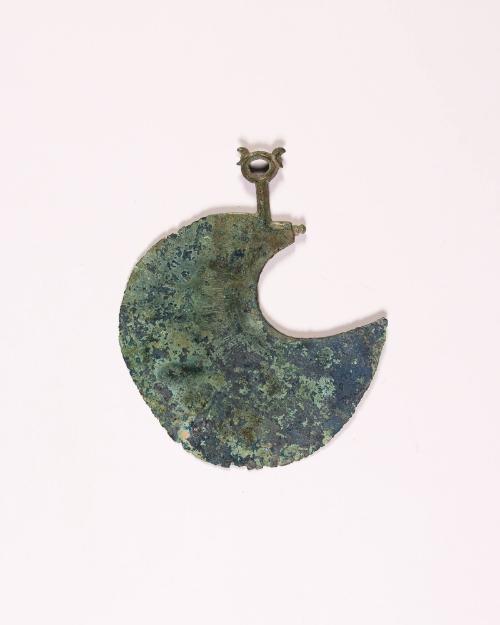


Crescent-Shaped Razor with Incised Decoration
Place of OriginItaly, Etruria
Date750-650 BCE
DimensionsMax H: 3 5/16 in. (7.2 cm); Max W: 4 in. (10.2 cm)
MediumBronze (cast, hammered/raised, and incised)
ClassificationMetalwork
Credit LineGift of an anonymous donor
Object number
1992.37
Not on View
DescriptionA crescent-shaped blade formed from a thin sheet of hammered bronze. The blade curves into a semi-circle, with one end tapering to a point and the other terminating in a cast handle. The handle features a circular loop surmounted by two stylized, opposing crescent-shaped protrusions. The surface of the blade is decorated with incised geometric patterns, consisting of concentric arcs following the curve of the spine and a band of short, radiating lines extending toward the cutting edge.
Label TextThis crescent-shaped razor is a rare example of personal grooming equipment from the Villanovan culture, the earliest Iron Age civilization of central Italy and the direct ancestors of the Etruscans. Hammered to the thickness of a wafer, the blade displays remarkable craftsmanship, combining functional design with ritual elegance. The surface is engraved with delicate geometric bands and radiating lines, motifs often interpreted as solar symbols in Villanovan art.
Such razors were typically found in the graves of elite men, suggesting that shaving was not just a daily routine but a significant social or ritual act, possibly marking a rite of passage. The stylized handle, featuring two horn-like projections, may represent simplified bird heads, a common protective motif of the period.
Comparative ReferencesSee also Cristofani, M. The Etruscans, A New Investigation, New York, 1979, p. 55, illus., an example from the Museo Archaeologico, Grosseto.
400-300 BCE
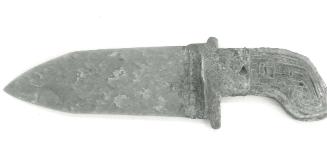
Shang Dynasty (1766-1045 BCE)

750-650 BCE
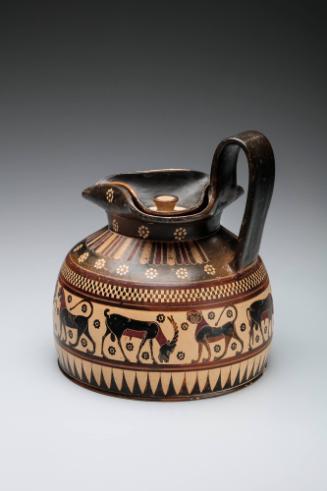

1st century CE

12th-11th century BCE


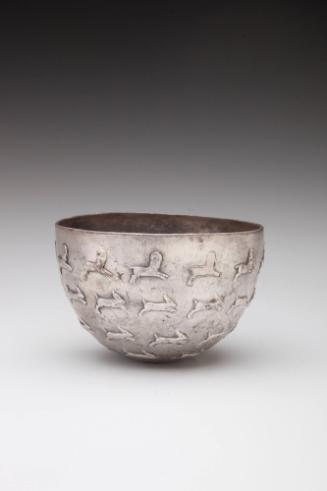
about 550-400 BCE


Membership
Become a TMA member today
Support TMA
Help support the TMA mission