

Scallop Shell Dish
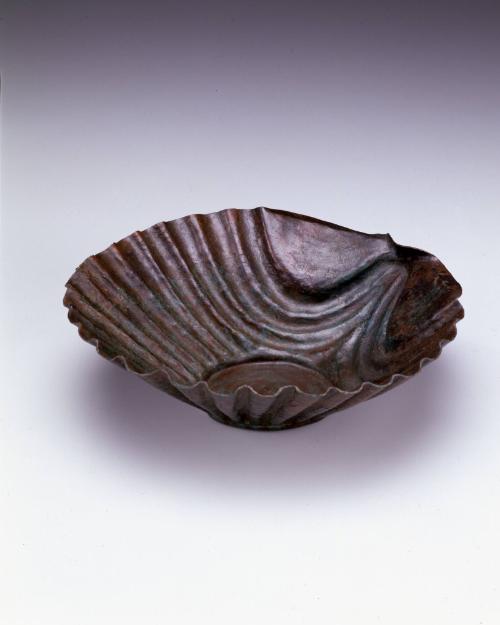


Scallop Shell Dish
Place of OriginPossibly Italy
Date1st century CE
DimensionsH: 2 in. (5.1 cm); W. (max.): 7.2 cm (2 13/16 in.)
MediumBronze (cast, hammered, and lathe-finished)
ClassificationMetalwork
Credit LineGift of Dennis and Joyce Kapp
Object number
1983.17
Not on View
DescriptionA bronze vessel cast and hammered in the form of a stylized bivalve scallop shell. The basin is deep with a scalloped rim, featuring prominent, radiating ribs that converge at a hinged section at the back, resembling the natural articulation of a pecten shell. The surface features a dark patina with areas of green corrosion and crystallization. The ribs appear skeletal and highly stylized compared to naturalistic examples.
Label TextThis Roman bronze vessel mimics the form of a scallop (bivalve) shell, characterized by deep, radiating ribs and a scalloped rim. Cast and finished with hammering and potentially lathe-work, the object exemplifies the Roman penchant for skeuomorphic vessels—objects created in one material to resemble another (in this case, natural sea shell).Published ReferencesPage, Jutta-Annette, The Art of Glass: Toledo Museum of Art, Toledo, Ohio, Toledo Museum of Art, 2006, repr. (col.) fig. 9.1, p. 35.

Probably first half of 4th century CE
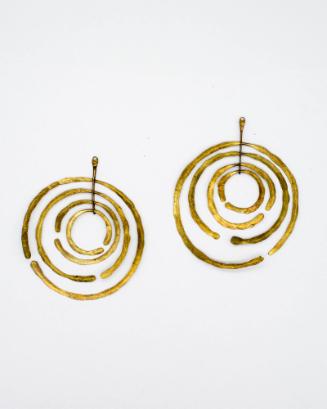


750-650 BCE
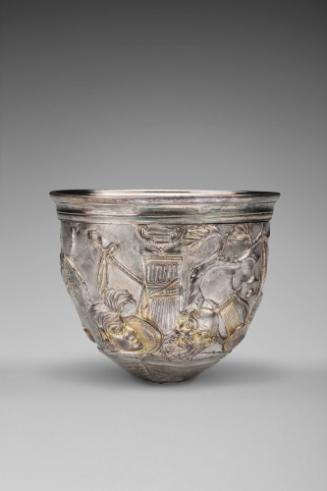
about 10-50 CE
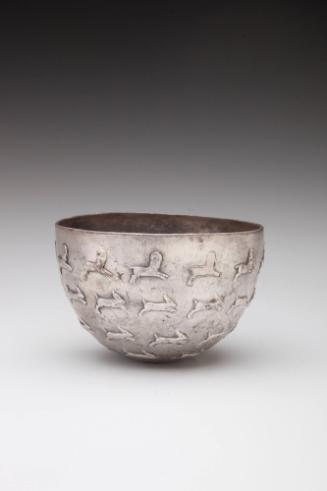
about 550-400 BCE
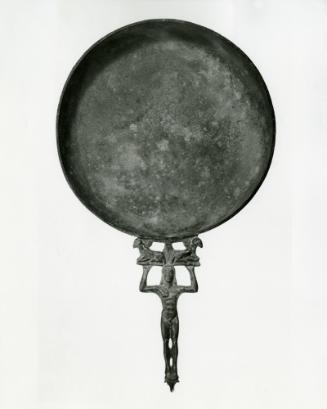

1375-1300 BCE

Late 3rd to mid-4th century CE
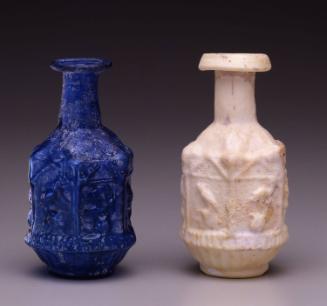
Probably second quarter of 1st century
Ptolemaic Period (332–30 BCE), about 200–50 BCE

Membership
Become a TMA member today
Support TMA
Help support the TMA mission