

Piriform (Pear-Shaped) Jar with Sea Creatures

Piriform (Pear-Shaped) Jar with Sea Creatures
Place of OriginGreece, reportedly found near Argos, stylistically attributed to Ialysos (Rhodes)
Date1375-1300 BCE
DimensionsH: 16 1/8 in. (40.9 cm); Max Diam (body): 42 5/32 in. (107.1 cm); Diam (lip): 6 5/16 in. (16 cm); Diam (foot): 4 5/8 in. (11.7 cm)
MediumWheel-thrown, slip-decorated earthenware
ClassificationCeramics
Credit LinePurchased with funds from the Libbey Endowment, Gift of Edward Drummond Libbey
Object number
1965.173
Not on View
DescriptionA large, wheel-thrown piriform jar (Furumark shape 35) composed of reddish clay with a smooth yellow-buff surface and red-brown slip decoration. The vessel features a broad, downward-tapering body, a wide spreading foot, and a concave neck terminating in a sloping, bevelled lip. Three vertical, ribbon-like S-curve handles are attached to the shoulder; small drying/firing holes are pierced through the vessel wall beneath the handle attachments and through the disc foot. The decorative scheme is concentrated on the shoulder zone, featuring a frieze of stylized argonauts (paper nautiluses) with spiral tentacles, interspersed with bivalve shell motifs and chevron-filled arches. The lower body is encircled by bands of varying thickness. The neck and foot are solid painted, and the flat rim features concentric circles.
Label TextNotice the small holes located underneath the handles of this jar. This crucial feature allowed for uniform drying of the clay and was a common practice for larger pieces of Mycenaean ceramic art (see also the Beaked Jug). The holes are located near especially thick regions in the vessel and helped to minimize the hazard of drying cracks. A horizontal band of clam-like shells and argonauts, a relative of the octopus, decorate the shoulder of this jar, emphasizing the strong ties that the Mycenaean people had to the sea. Although the dealer from whom this vessel was acquired stated, without evidence, it was found at Argos in the Peloponnese, its style more closely resembles examples found at Ialysos on the island of Rhodes.Published References"Accessions of American and Canadian Museums," Art Quarterly, vol. 30, no. 2, 1967, pp. 153, 155.
Vermeule, Emily, "Myths, Shapes and Colors," Apollo, vol. 86, no. 70, 1967, p. 418, fig. 1.
Riefstahl, Rudolph, "Greek Vases," Toledo Museum of Art Museum News, vol. 11, no. 2, 1968, p. 29.
Lakofsky, Charles, Pottery, Dubuque, 1968, p. 84, fig. 83.
Ebertshauser, Heidi C. and Michael Walts, Antiken I, Vasen-Bronzen-Terrakotten des klassischen Altertums, Munchen, 1981, p. 29, fig. 25.
Boulter, Cedric G., and Kurt T. Luckner, Corpus Vasorum Antiquorum, Toledo Museum of Art fasc. 2, U.S.A. fasc. 20, Mainz, 1984, pl. 62.

1375-1300 BCE
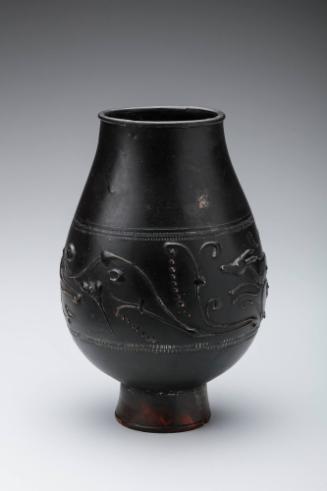
2nd century CE
3rd to 1st century BCE
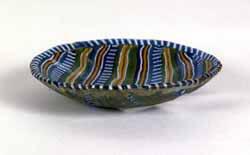
Early to mid-1st century CE
2nd century BCE to 1st century CE, possibly later

1400-1300 BCE
Workshop of the potter Nikosthenes
about 520 BCE
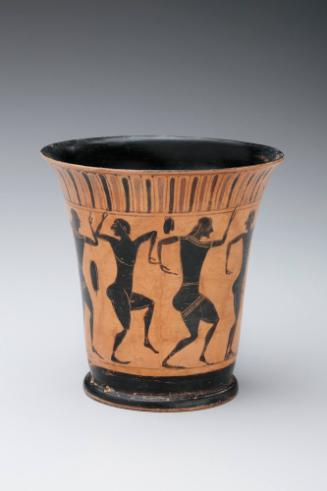
about 540 BCE
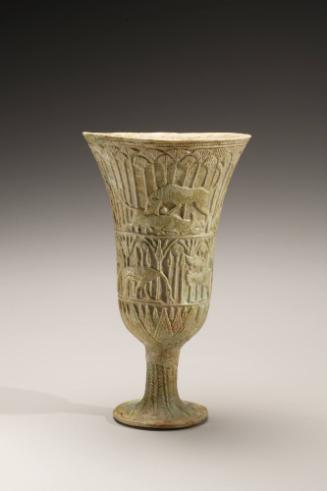

Membership
Become a TMA member today
Support TMA
Help support the TMA mission