

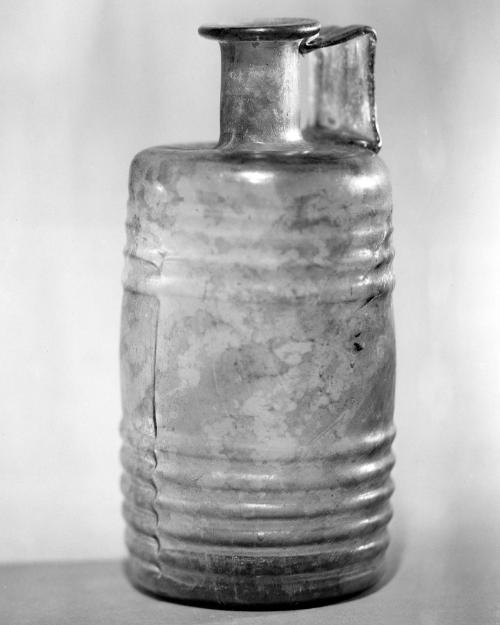
Barrel-Shaped Jug Signed by Frontinus

Barrel-Shaped Jug Signed by Frontinus
Place of OriginFrance, found in Amiens (1888)
Date3rd century CE
DimensionsH: 8 3/4 in. (22.2 cm); Diam: 4 1/8 in. (10.5 cm)
MediumGlass; mold-blown.
ClassificationGlass
Credit LinePurchased with funds from the Libbey Endowment, Gift of Edward Drummond Libbey
Object number
1948.220
Not on View
DescriptionA mold-blown bottle of transparent natural green glass imitating the form of a wooden barrel. The body is cylindrical with a slight barrel curve, decorated with horizontal relief ribs representing wooden hoops: four clustered near the shoulder and six near the base. The shoulder is horizontal, leading to a cylindrical neck with a constriction at the base and a hollow rim folded outward, upward, and inward. A broad strap handle with three vertical ribs connects the shoulder to the neck. The concave underside features a mold-blown relief inscription reading FROTINIANA surrounding a central circle. A mold seam is visible running vertically from the rim to the base.
Label TextThis vessel is a characteristic example of the Frontinus bottle (Isings Form 89), a type of mold-blown container produced in Roman Gaul during the late 3rd and 4th centuries A.D. The form is skeuomorphic, replicating the wooden barrels used for wine storage in the northern provinces of the Empire. The body features horizontal ribs imitating hoops, and the base carries the workshop stamp FROTINIANA (intended as Frontiniana). The misspelling, omitting the first "N," is attributed to an error by the mold-cutter.
The bottle was blown into a multi-part mold—likely two vertical sections for the body and a separate base plate for the inscription—allowing for mass production and consistent branding. The distinct distribution of these stamped vessels suggests they may have been used to market the product of a specific vineyard or region, functioning as one of the earliest examples of branded packaging in the ancient world.
This bottle was reportedly found at Amiens, France, in 1888 (or 1890). It was subsequently part of the collection of Sir John Evans (1823–1908), a renowned English archaeologist and numismatist, in London.
Published ReferencesLabino, Dominick, Visual Art in Glass, Dubuque, IA, 1968, p. 29, repr. fig. 18.Riefstahl, Rudolph, "Ancient and Near Eastern Glass," Museum News, New Series, vol. 4, no. 2, 1961, p. 38 (repr.).
Toledo Museum of Art, Art in Glass, A Guide to the Glass Collections, 1969, p. 27, repr.
Fundaburk, Emma Lila and Thomas G. Davenport, Art in Public Places in the United States, Bowling Green, 1975, p. 253, p. 183.
Grose, David, "Ancient Glass," Toledo Museum of Art Museum News, vol. 20, no. 3, 1978, p. 81, repr. fig. 17.
Grose, David, "The Origins and Early History of Glass," in The History of Glass, London, 1984, repr. p. 31.
Groffi, T. and J. Heus, Beschavingen 2, Antwerp, 1990, repr. p. 241.
Stern, E. Marianne, "Roman Glassblowing in a Cultural Context," American Journal of Archaeology, vol. 103, no. 3, July 1999, p. 462, 467, fig. 26.
Cummings, Keith, A Histoy of Glassforming, London, 2002, p. 80, repr.
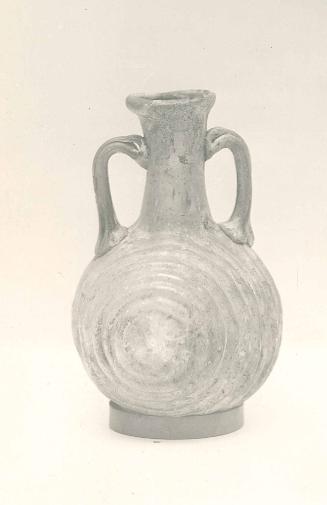
Probably second half of the 1st century
Probably second half of the 1st century

Mid-1st century CE
Probably second half of 1st century
Probably second half of 1st century

6th to early 7th century
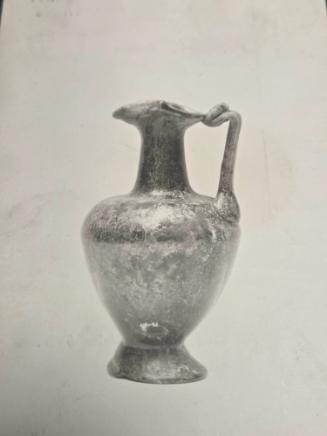
Probably 4th century
Probably second quarter of the 1st century

Probably second quarter of the 1st century
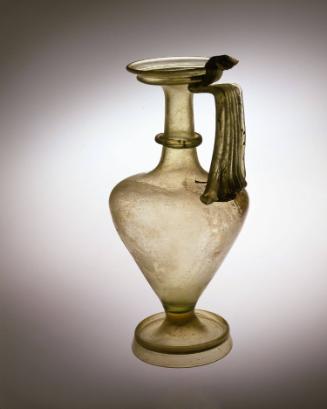
4th century CE

Probably mid-4th to early 5th century

Membership
Become a TMA member today
Support TMA
Help support the TMA mission