

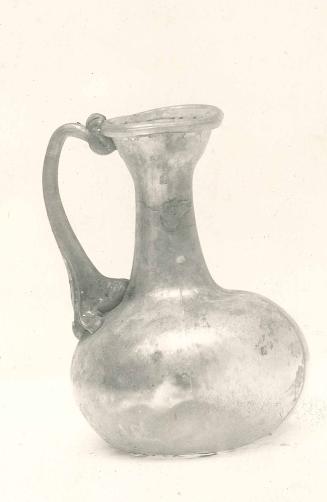
Pitcher with Cylindrical Neck and Flanged Foot


Pitcher with Cylindrical Neck and Flanged Foot
Place of OriginEastern Mediterranean (possibly Syria)
Date4th century CE
DimensionsH (to top of handle): 12 5/8 in. (32.1 cm)
H (to mouth): 12 1/4 in. (16.7 cm);
Mouth Diam: 4 7/32 in. (10.7 cm);
Base Diam: 4 7/16 in. (11.3 cm);
Weight: 901.5 g
(1 lb. 15.8 oz.)
H (to mouth): 12 1/4 in. (16.7 cm);
Mouth Diam: 4 7/32 in. (10.7 cm);
Base Diam: 4 7/16 in. (11.3 cm);
Weight: 901.5 g
(1 lb. 15.8 oz.)
MediumGlass; mold-blown, tooled, applied, wheel-cut.
ClassificationGlass
Credit LinePurchased with funds from the Libbey Endowment, Gift of Edward Drummond Libbey
Object number
1979.54
Not on View
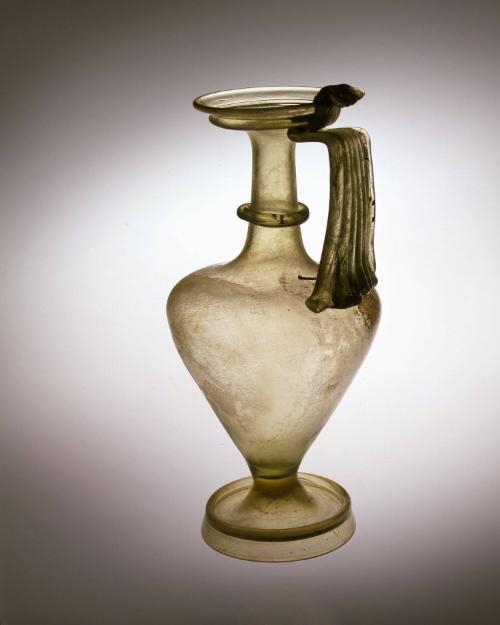
DescriptionThis large, pale-green glass ewer features a tall, inverted conical body that tapers sharply to a point before flaring into a high, concave foot with a distinct "collar-like" flange around its outer edge. The vessel has a cylindrical neck that transitions smoothly into a sloping shoulder and terminates in a wide, flaring circular mouth with a rounded lip; a thick trailed band reinforces the underside of the rim. A broad, strap-like handle with seven vertical ribs connects the shoulder to the rim, featuring a prominent thumb-rest at the top. The vessel was formed by mold-blowing and tooling, with applied trails and handle.
Label TextThis elegant pitcher mimics the shape of luxury silver vessels used in Late Roman dining. Its sharp, metallic profile—evident in the crisp collar around the foot and the ribbed strap handle—demonstrates how skilled glassmakers copied expensive metal prototypes to create affordable yet stylish tableware. The pale green color is natural to the glass, while the sturdy handle and wide mouth suggest it was used for serving wine or water at banquets. Acquired from the celebrated Constable-Maxwell collection, this piece is remarkable for its large size and excellent preservation.Published ReferencesCatalogue of the Constable-Maxwell Collection of Ancient Glass, Sotheby Parke-Bernet and Co., London, June 4-5, 1979, p. 124, lot no. 217, repr. (col.).
"Current Exhibitions," Archaeology, vol. 33, no. 1, Jan/Feb 1980, p. 4, and no. 2, Mar/Apr 1980, p. 2.
1979 Annual Report, Toledo Museum of Art News, vol. 21, no. 4, p. 79 repr.
Dragadze, Peter, "Of Passion and Profit, " Connoisseur, vol. 217, no. 909, Oct, 1987, repr. p. 187 (col.).
Page, Jutta-Annette, The Art of Glass: Toledo Museum of Art, Toledo, OH, Toledo Museum of Art, 2006, p. 38, repr. (col.) p. 39.
Exhibition HistoryWorcester Art Museum; Cleveland Museum of Art; Baltimore Museum of Art, Antioch: The Lost Ancient City, 2000-2001, no. 82, p. 195, repr. (col.).
3rd century BCE
Probably second quarter to mid-1st century
Probably mid-1st century

4th century

4th-3rd century BCE

about 300 BCE
Late 6th through 5th century BCE
6th to early 7th century

3rd-4th century CE

Membership
Become a TMA member today
Support TMA
Help support the TMA mission