

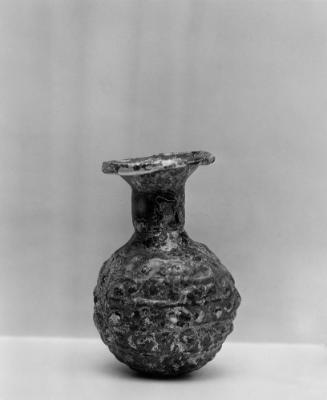
Sprinkler Flask with Inner Diaphragm

Sprinkler Flask with Inner Diaphragm
Place of OriginLebanon, reportedly from Baalbek
Date3rd-4th century CE
DimensionsH: 3 3/8 in. (8.6 cm); Rim Diam: 1 7/8 in. (4.8 cm); Body Diam: 2 1/2 in. (6.4 cm)
MediumGlass; blown in a mold, removed, free blown
ClassificationGlass
Credit LineGift of Mr. and Mrs. Preston Levis
Object number
1967.152
Not on View
DescriptionA bulbous bottle blown of transparent natural grayish yellow-green glass containing small bubbles, black specks, and blowing spirals. The vessel was blown into a vertically grooved cylindrical mold and subsequently expanded, resulting in approximately 18 indistinct vertical ribs that widen toward the greatest diameter of the body. The rim is outsplayed horizontally, rounded, and thickened in the flame. The neck is tall, tubular, and slightly tapering, featuring a constriction at its base where an interior cut-out forms a diaphragm with a small aperture (approx. 0.6 cm). The bottom features a concave base with a pontil mark over a reamer mark. The exterior surface is weathered and rough, while the interior shows an iridescent film.
Label TextThis modest ancient bottle is a testament to Toledo’s role as the "Glass City" of the 20th century. It arrived in Toledo in 1967, carried by two titans of Italian industry: Dr. Nino Maderna and Giuseppe Clinanti. As leaders of the Riccardi Group, Italy’s largest manufacturer of glass containers, they came to pay respects to J. Preston Levis, Chairman of the Board of Owens-Illinois, Inc.
The gift was symbolic. Reportedly recovered from a tomb in Baalbek, Lebanon, this flask was mass-produced in the Roman Levant, the ancient birthplace of glassblowing. By presenting an ancient commercial vessel to the leader of the world’s premier modern glass company, the Italian delegation connected their shared industrial heritage across 1,600 years of history.
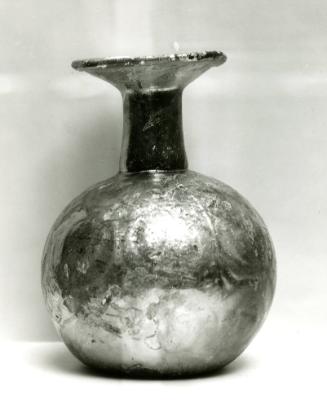
3rd-4th century CE

3rd-4th century CE
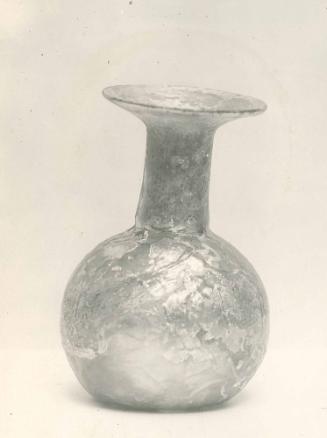
5th-6th century CE

3rd-4th century CE
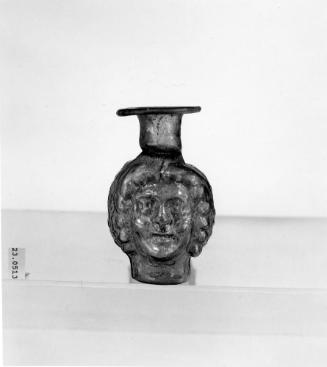
Nineteenth century
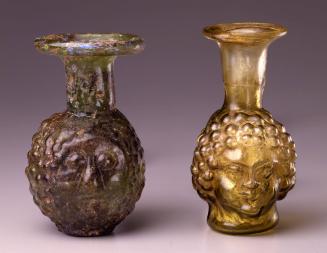
Probably early 3rd century

Probably 3rd century
3rd-4th century CE

Membership
Become a TMA member today
Support TMA
Help support the TMA mission