

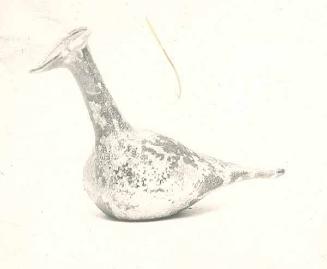
Bird-Shaped "Baby Feeder" (Dropper)
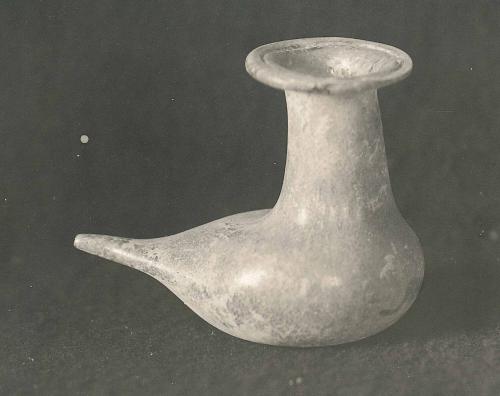

Bird-Shaped "Baby Feeder" (Dropper)
Place of OriginCyprus, excavated by 1873
Date1st-2nd century CE
DimensionsGlass Dimensions: 3 × 1 11/16 × 2 3/16 in. (7.6 × 4.3 × 5.6 cm)
Mediumglass
ClassificationGlass
Credit LineMuseum Purchase
Object number
1916.161
Not on View
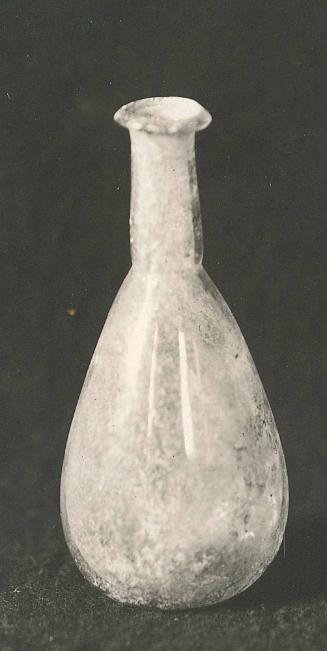
DescriptionThis bird-shaped vessel, likely used as a filler or dripper, is made of medium thin, transparent natural green glass (5 G 7/2) and contains a few small bubbles. The form was free-blown and finished with tooling. A circular scar approximately 2.1 cm in diameter is visible on the base.
The vessel takes the form of a stylized bird, with a large circular opening at the front, where the head would be, and a secondary opening at the tail. The horizontally everted rim is folded outward, downward, upward, and then inward. The tall cylindrical neck tapers smoothly into a rounded shoulder. The body is bulbous and triangular, terminating in a short tail that is pierced lengthwise and rounded in flame. The flattened base ensures stability.
Eastern examples of similar bird-shaped glass vessels are documented in Stern (1977, p. 51), often interpreted as fillers for lamps. See also comparable examples in the TMA collection: 1923.1086, 1923.1087, and 1923.1088. Parallels with trefoil-shaped mouths are illustrated in Platz-Horster 1976, nos. 136–137. Additional examples from Tyre, associated with coin finds dated between 197 and 379 CE, are published by Chéhab (1986, pls. XLV–XLVI).
Label TextThis charming vessel, shaped like a swimming bird, is more than a decorative toy. Roman glassblowers created these zoomorphic containers with two openings: a wide mouth at the top of the neck for filling, and a tiny, pierced hole at the tip of the tail for pouring. Archaeologists and art historians have long debated their specific function. While some suggest they were used as "sippy cups" for babies (known as a gutus), the awkward positioning of the spout makes this difficult. A more likely theory is that they served as "droppers" to refill oil lamps with precision. This piece was excavated in Cyprus by Luigi Palma di Cesnola in the 19th century.Comparative ReferencesCf. Antonaras, Anastassios, Ancient Glass in the J. Paul Getty Museum, Los Angeles, J. Paul Getty Museum, 2025, cat. no. 285.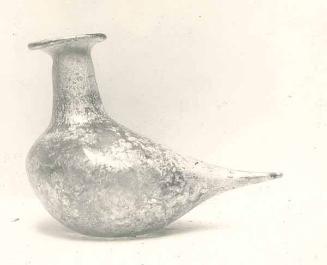
1st-2nd century CE
1st-2nd century CE
1st-2nd century CE
1st-2nd century CE
1st-2nd century CE
1st-2nd century CE
1st-2nd century CE
Pierre Delabarre
Glass: before 1630; Mount: c. 1630; Case: c. 1700
possibly 1st century

Probably 2nd century

Membership
Become a TMA member today
Support TMA
Help support the TMA mission