

Double Convex Bottle
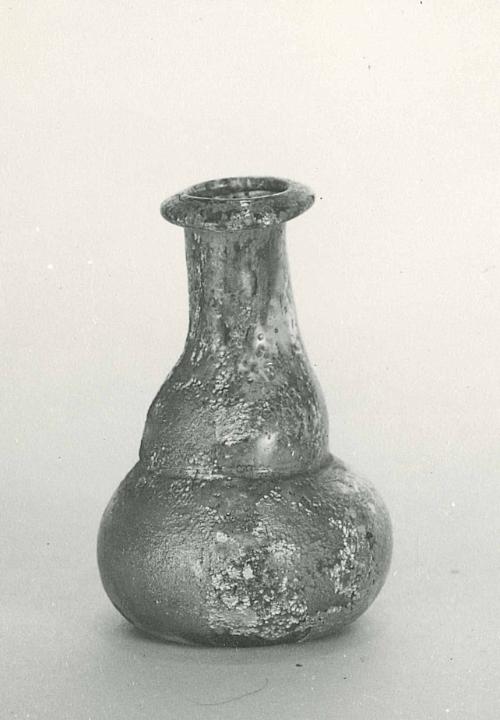

Double Convex Bottle
Place of OriginCyprus, excavated by 1873
Date1st-2nd century CE
DimensionsGlass Dimensions: 1 3/4 × 5/8 × 1 3/16 in. (4.4 × 1.6 × 3 cm)
Mediumglass
ClassificationGlass
Object number
1916.162
Not on View
DescriptionThis double convex bottle is made of thin, transparent decolored glass with a pale green tinge and contains a few pinprick bubbles. The form was free-blown and finished with tooling. The triangular rim is folded outward, upward, inward, and flattened. A cylindrical neck with a constriction at its base joins a symmetrical double convex body, marked by a central constriction. The base is flattened with a slight central depression, and there is no evidence of a pontil mark.
This shape is closely related to other examples in the Toledo collection (1923.1147, 1923.1148, and 1916.0162). Comparative examples are illustrated in Vessberg 1952 (pl. VII, nos. 28–29). Hayes 1975 (no. 215, fig. 8, pl. 10) cites no further parallels. Barag’s discussion of this form in the context of Palestinian and Syro-Palestinian contexts includes examples from Dominus Flevit, Nazareth, Huqoq, and Amman (see Barag 1970, pl. 13).
Label TextThis small object marks a formative moment in the Toledo Museum of Art’s “teenage years.” In 1916, the museum made a deliberate decision to collect Greek and Roman antiquities more systematically, acquiring a group of eighty-eight ceramic, bronze, and glass objects from the Metropolitan Museum of Art in New York. All were excavated on Cyprus by Luigi Palma di Cesnola (1832–1904), the Met’s first president, and entered Toledo’s collection when the institution was still defining the scope of its antiquities holdings.
The bronze objects (1916.134–1916.149) reflect Cyprus’s early mastery of copper, a resource so central to the island that its Latin name, cuprum, derives from Cyprus itself. Bronze Age weapons, including a dagger (1916.149), attest to early casting traditions, while later Roman-period tools reveal long-term continuity in everyday practices. Tweezers (1916.147), cosmetic implements (1916.144–145), mirrors (1916.135–136), and a rare buckle (1916.146) point to routines of personal care across centuries.
The glass vessels (1916.150–1916.165) document a different technological transformation. Most are Roman blown glass, produced after the invention of the blowpipe in the first century BCE, a development that shifted glassmaking from a luxury craft to large-scale production. One earlier ribbed bowl (1916.153), formed by slumping glass over a mold, preserves an older and more labor-intensive technique.
The acquisition also included several dozen ceramic vessels. Over time, the scope of the museum’s collection evolved, and most of these ceramics were later deaccessioned. Two Archaic vessels from Cyprus, a stamnos (1916.79) and an oinochoe (1916.96), remain in the collection as representatives of this early phase of collecting.
Comparative ReferencesSee also Vessberg 1952, pl. VII nos. 28-29. Hayes 1975, no. 215 fig. 8 and pl. 10 gives no other parallels except Vessberg. Check Bagatti and Milik, Dominus Flevit A II 226-233 (dated ? mid 3 c by Barag) but cf. Franciscans in Nazareth 71, Barag 1970 (pl. 13) dated 2nd quart - end of 1st c and idem(?) from Huqoq. Amman in QDAP.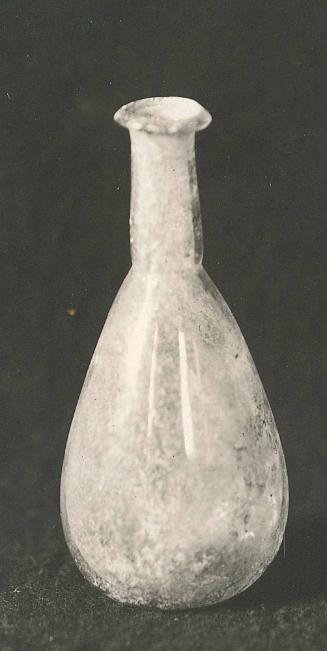
1st-2nd century CE
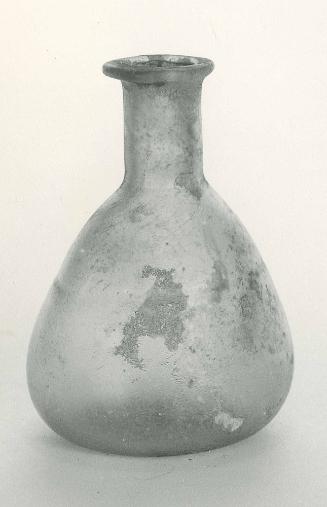
1st-2nd century CE
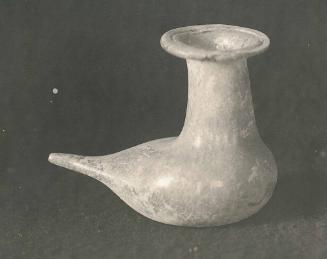
1st-2nd century CE
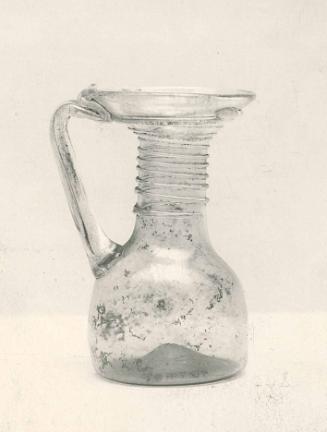

Probably 2nd century
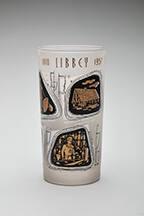
Libbey Glass Company, an operating division of Owens-Illinois Glass Company
1957
4th century

1st-2nd century CE
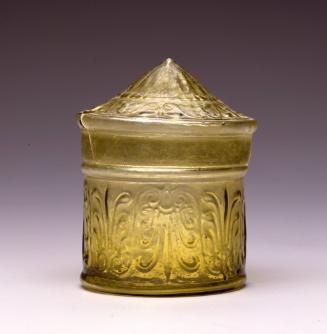
Second half of the 1st century CE

about 450-430 BCE

1st century CE

Membership
Become a TMA member today
Support TMA
Help support the TMA mission