

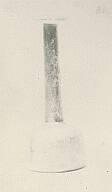
Cylindrical Bottle on Base Ring

Cylindrical Bottle on Base Ring
Place of OriginRoman Empire
Date1st century
DimensionsH: 4 1/8 in. (10.5 cm); Rim Diam: 7/8 in. (2.2 cm); Diam (body): 1 7/8 in. (4.7 cm); Base Diam: 1 3/8 in. (3.5 cm)
MediumBlown and tooled, foot applied
ClassificationGlass
Credit LineGift of Edward Drummond Libbey
Object number
1923.1471
Not on View
DescriptionThis free-blown bottle is made from translucent amber glass embedded with numerous thin opaque white canes. These canes create a dense, jumbled pattern that resembles fireworks. The glass shows pinprick bubbles in the body and vertically elongated bubbles in the neck.
The rim is folded outward, then upward, and inward. The bottle has a tall, tapering neck with a visible tool mark at its base, a sloping shoulder, and a cylindrical body that tapers slightly downward. The flat base has an open, pushed-in base ring.
The technique that produced this striking pattern remains unusual and is not fully understood, though it resembles serpentine glass.
1st-2nd century CE
1st-2nd century CE
Mid-1st to early 2nd century CE

First half of 3rd century CE
Probably mid-1st century

2nd-4th century CE

18th Dynasty (1550-1292 BCE), about 1397-1360 BCE

Late second to mid-3rd century


Membership
Become a TMA member today
Support TMA
Help support the TMA mission