
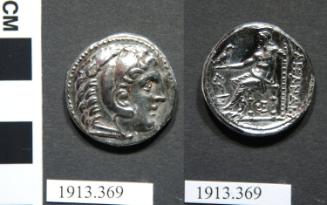
Celtic Silver "Tetrobol" Imitating Alexander the Great
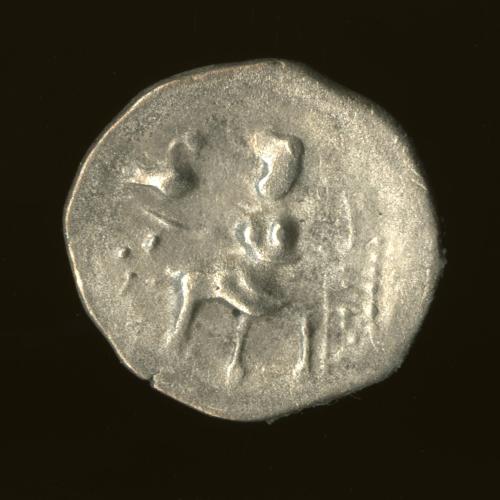


Celtic Silver "Tetrobol" Imitating Alexander the Great
Place of OriginPossibly from Central Europe (Pannonia)
Date2nd Century BCE
DimensionsMax L: 20.08 mm (2 cm); H: 2.77 mm (0.3 cm); Weight: 3.19 grams
MediumSilver.
ClassificationMetalwork
Credit LineGift of the Popplestone Family
Object number
2006.112
Not on View
DescriptionA Celtic silver fraction (often called a tetrobol) from the Danube region, imitating the drachms of Alexander III. It features a simplified head of Herakles in lion skin and a seated Zeus on the reverse (ref: Göbl OTA Class V/VI).
Label TextThe coinage of Alexander the Great was the "universal currency" of the Hellenistic world, recognized from Greece to India. This small silver coin shows how that imagery was adopted by non-Greek peoples in Central Europe. While the motifs—Herakles and Zeus—remain recognizable, the Celtic engraver has reduced them to their essential geometric forms. These coins circulated widely in the Balkans, facilitating trade between the Classical world and the tribal societies to the north.
2nd-1st century BCE

about 320-319 BCE

1st century BCE

after 146 BCE


321-281 BCE
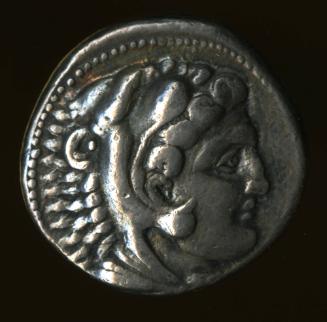
about 333 BCE

about 333 BCE

about 333 BCE



Membership
Become a TMA member today
Support TMA
Help support the TMA mission