

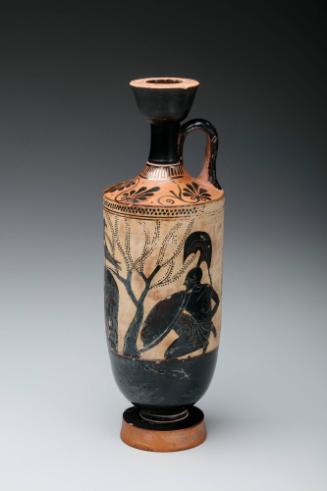
Lekythos with Herakles and the Sleeping Giant Alkyoneus

Lekythos with Herakles and the Sleeping Giant Alkyoneus
Artist
The Leagros Group
(Greek)
Place of OriginMade in Athens; reportedly found in Gela, Sicily.
Dateabout 510 BCE
DimensionsH: 10 1/4 in. (26 cm); Diam (lip): 2 9/16 in. (6.5 cm); Diam (foot): 3 1/8 in. (8 cm)
MediumBlack Figure; Wheel-thrown, slip-decorated earthenware with incised details.
ClassificationCeramics
Credit LinePurchased with funds from the Libbey Endowment, Gift of Edward Drummond Libbey
Object number
1952.66
Not on View
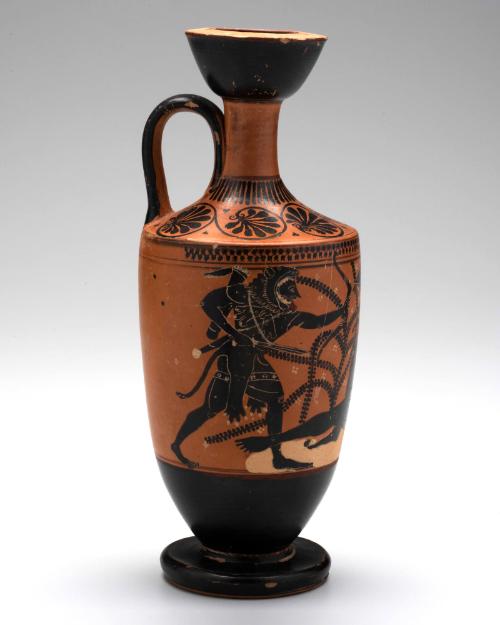
DescriptionA wheel-thrown ceramic oil flask (lekythos) with a narrow neck, deep mouth, and single vertical handle. The body tapers to a disc foot. The surface is decorated in the black-figure technique with incised details and added red and white pigments. The shoulder features a frieze of five palmettes alternating with ivy leaves. The main body scene depicts a bearded Herakles, wearing a lion skin over a short chiton, advancing from the left with a sword and bow. He attacks the bearded giant Alkyoneus, who reclines awkwardly on a rock, his body twisting between frontal and profile views. A small, winged youth (Hypnos) hovers horizontally above the giant. Leafy branches with white blossoms fill the background.
Label TextThis oil jar captures a tense moment from the Gigantomachy, the cosmic battle between gods and giants. The hero Herakles creeps forward with sword drawn to ambush the giant Alkyoneus, who is immortal only within his homeland. The giant lies in a fitful, restless sleep—notice how his body twists awkwardly, tipping forward as if about to wake or fall, while his fingers curl into the rock for support. Hovering above him is the tiny, winged figure of Hypnos (Sleep), casting the spell that renders the giant vulnerable. This vessel was likely used in funeral rites and was reportedly found in a tomb in Gela, Sicily.Published ReferencesBothmer, Dietrich von., "Book Review Section," American Journal of Archaeology, vol. 61, 1957, p. 105.
Brommer, F., Vasenlisten zur griechischen Heldensage, 2nd ed., 1960, p. 4, no. A20.
Andreae, Bernard, "Herakles and Alkyoneus," Jahrbuch des Deutschen Archaologisches Instituts, vol. 77, 1962, p. 170-171, figs. 21-22, p. 169.
Washington, Seldon, "Greek Vase Painting," Toledo Museum of Art Museum News, vol. 5, no. 4, 1962, p. 91.
Fellmann, Berthold, Die Antiken Darstellungen des Polyphemabenteuers, Munich, 1972, p. 29.
Luckner, Kurt T., "Greek Vases: Shapes and Uses," Toledo Museum of Art Museum News, new series, vol. 15, no. 3, 1972, repr. on cover.
Brommer, F., Vasenlisten zur griechischen Heldensage, 3rd ed., 1973, p. 6, no. A20.
Boulter, Cedric G., and Kurt T. Luckner, Corpus vasorum antiquorum: Toledo Museum of Art, U.S.A. fasc. 17, Toledo, 1976, p. 20, repr. pl. 27, 3 & 4 and 28,1.
Lexicon iconographicum mythologiae classicae (LIMC), Zurich, 1981, v. I, pt. 1, p. 560, no. 7, repr. v. I, pt. 2, p. 419.
Brommer, Frank. Herakles. 2: Die unkanonischen Taten des Helden, Darmstadt, Wissenschaftliche Buchgesellschaft, 1984, pl. 18b.
Archailogika Analekta ex Athenon, vol. 20, 1987, p. 163, fig. 3.
Moon, Warren G., "Some new and little-known vases by the Rycroft and Priam Painters," Greek Vases in the J. Paul Getty Museum, vol. 2, Malibu, 1985, repr. fig. 25 a-b.
Shapiro, Harvey Alan. Personifications in Greek Art: The Representation of Abstract Concepts, 600‑400 B.C., Zürich (Kilchberg/ZH), Akanthus, 1993, p. 150, fig. 105.
Dietrich, Nikolaus. Figur ohne Raum?: Bäume und Felsen in der attischen Vasenmalerei des 6. und 5. Jahrhunderts v. Chr., Berlin and New York, De Gruyter, 2010, 352-353, fig. 287.
Comparative ReferencesSee also Haspels, C.H. Emilie, Attic Black-figured Lekythoi, 1936, pp. 43 ff. (on lekythoi of the Leagros Group)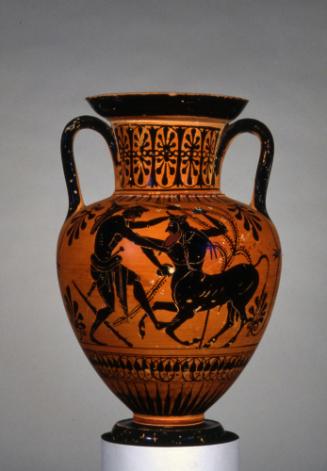





Membership
Become a TMA member today
Support TMA
Help support the TMA mission