

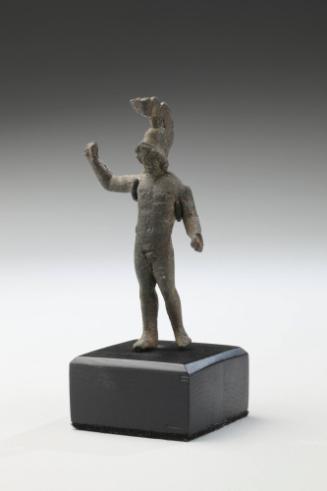
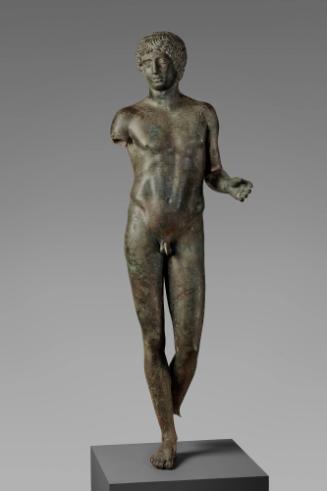
Votive Figure of a Youth (Hercules?)
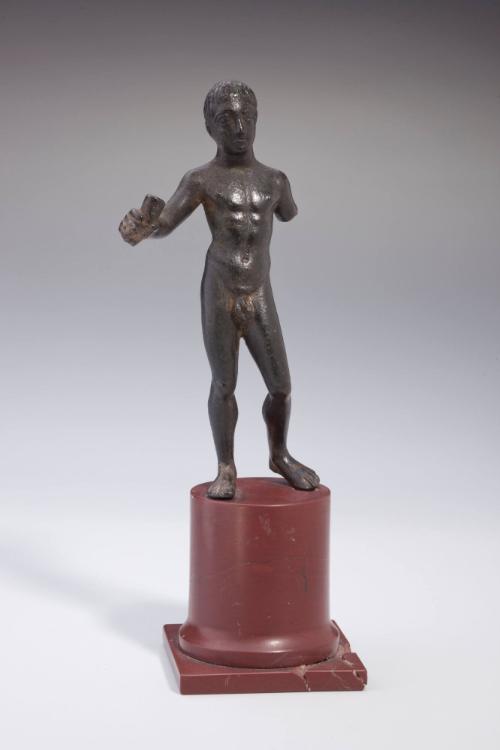

Votive Figure of a Youth (Hercules?)
Place of OriginItaly
Datelate 4th-late 1st Century BCE
DimensionsH: 4 3/4 in. (12.1 cm); L: 2 7/16 in. (6.2 cm); W: 1 5/8 in. (4.2 cm)
MediumBronze
ClassificationSculpture
Credit LineGift of the Popplestone Family
Object number
2006.93
Not on View
DescriptionA small, solid-cast bronze statuette of a nude male youth, approximately 4 3/4 inches (12.1 cm) high. The figure stands in a relaxed contrapposto pose with weight resting on the right leg and the left knee slightly bent. The musculature is smooth and generalized. The right arm is extended forward, grasping a cylindrical object in a closed fist; while historically interpreted as a scroll, the form is consistent with a schematized club. The left arm is missing from just below the elbow. The head is beardless with short, cap-like hair,
Label TextThis small bronze figure was long cataloged as an "Orator" due to his extended right arm. However, a closer look reveals he is completely nude—a detail that changes his identity entirely. In the ancient world, civic officials (orators) always wore drapery to signify their status. A nude youth with a weapon or attribute is a hero or a god. Based on the cylindrical object in his right hand (likely a club) and his powerful, athletic build, this is possibly Hercle (the Etruscan Hercules).Published ReferencesThe Lester Wolfe Collection of Pre-Columbian Art and Antiquities, Sotheby's, New York, March 1–2, 1984, lot 269 (illus.)
. Antiquities, Sotheby's, New York, June 12, 2003, lot 187.
4th century BCE
about 150-50 BCE
1st-2nd century CE

6th century BCE

late 2nd century AD

2nd century CE
1st to 3rd century CE

100 BCE to 150 CE
about 2nd century CE
1st century BCE - 1st century CE
mid-2nd to early 3rd century CE (Severan?)

Membership
Become a TMA member today
Support TMA
Help support the TMA mission