

Early Italic Glass Bead

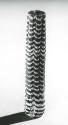
Early Italic Glass Bead
Place of OriginItaly, reportedly from Cerveteri
DateProbably 8th century BCE
DimensionsH: 2 3/8 in. (6.0 cm); Max Diam: 7/16 in. (1.1 cm)
MediumRod-formed glass with applied marvered threads
ClassificationGlass
Credit LineGift of Duane Wilder
Object number
1983.18
Not on View
DescriptionA long, cylindrical bead created by winding glass around a rod (rod-formed) coated with a granular separating agent. The body is composed of dark blue glass, which appears black, decorated with an opaque yellow thread. This thread was marvered (pressed flat) into the surface and tooled to create a festoon pattern, resulting in eight vertical indentations along the length of the bead. One end of the cylinder is slightly convex, while the other is flat, appearing as if cut crosswise. A longitudinal threadhole runs through the center, retaining traces of a fine brown separating agent.
Label TextThis cylindrical bead represents some of the earliest glass produced in Italy. Created before the widespread use of blown glass, it was made by winding hot glass around a rod coated in a clay-like mixture (the "separating agent") to keep it from sticking. The dark blue body was then decorated with a yellow thread, dragged into a zigzag "festoon" pattern—a design that mimics the expensive imported vessels of the time.
Scholars debate who made these early objects. Some believe migrant craftsmen from Mesopotamia established workshops in Italy, while others argue that local Etruscan artisans developed the technology independently, inspired by imported eastern goods.
Published ReferencesGrose, David F., Early Ancient Glass: Core-formed, Rod-Formed, and Cast Vessels and Objects from the Late Bronze Age to the Early Roman Empire, 1600 B.C. to A.D. 50, New York, Hudson Hills Press in association with the Toledo Museum of Art, 1989, cat. no. 35, p. 87, repr. (col.) p. 70.Koch, Leonie Carola, Die Glasbügelfibeln des 8. und 7. Jahrhunderts v. Chr. aus Etrurien: Ein Beitrag zur eisenzeitlichen Glastechnik und zu den Bestattungssitten des Orientalizzante (Universitätsforschungen zur prähistorischen Archäologie, Band 190), Bonn, Verlag Dr. Rudolf Habelt GmbH, 2010, Kat.-Nr. 189 [discussed in relation to 1986.82].
18th Dynasty (1550-1292 BCE), about 1400 to 1350 BCE
18th Dynasty (1550-1292 BCE), about 1400 to 1350 BCE

7th century BCE
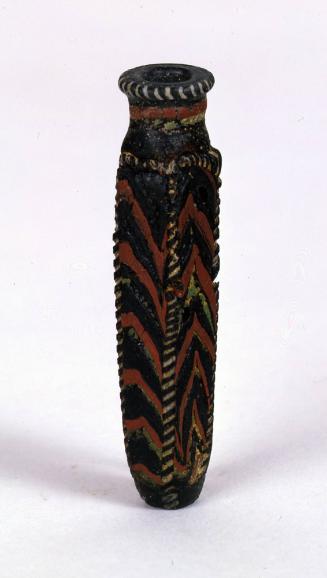
5th-4th century BCE, possibly later
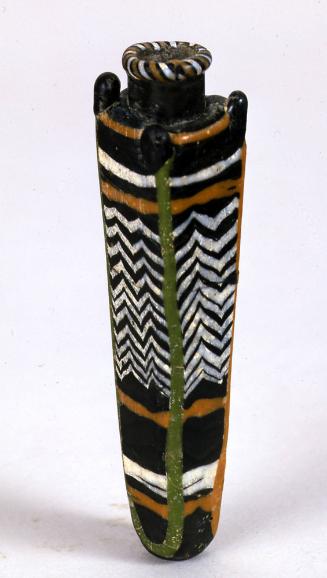
5th-4th century BCE

Late 18th or 19th Century (1400-1225 BCE)
6th through 5th century BCE
6th - 5th century BCE

9th-11th century CE (?)

Probably 4th century
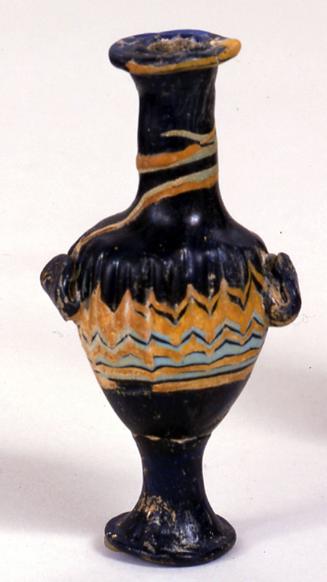
3rd century BCE

3rd century BCE

Membership
Become a TMA member today
Support TMA
Help support the TMA mission