

Earring with Eagle Grasping Thunderbolts
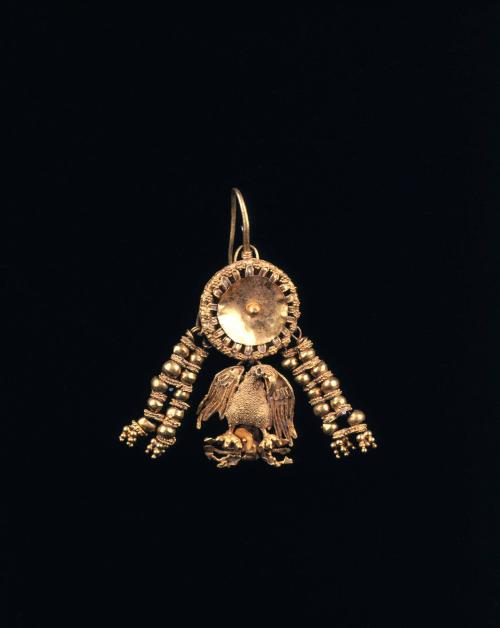


Earring with Eagle Grasping Thunderbolts
Place of OriginPossibly South Italian
Dateabout 220-130 BCE
Dimensions1 1/2 × 7/8 × 1/2 in. (3.8 × 2.2 × 1.3 cm)
MediumGold; repoussé, filigree, granulation
ClassificationJewelry
Credit LinePurchased with funds from the Libbey Endowment, Gift of Edward Drummond Libbey
Object number
2007.10
On View
Toledo Museum of Art (2445 Monroe Street), Gallery, 02, Classic
DescriptionThis multi-part earring consists of an elaborate gold sheet disc decorated with a central rosette composed of filigree and granulation attached to a wire ear loop. Suspended from the disc are two double side-pendants consisting of plain and granulated beads, flanking a central sculptural pendant. The central pendant depicts an eagle grasping a thunderbolt in its talons. The eagle's body, outspread wings, and legs are detailed with minute granulation, while the thunderbolts are formed from sheet gold. The reverse of the eagle is plain sheet gold.
Label TextThis intricate earring transforms a symbol of divine power into personal adornment. The central pendant depicts an eagle clutching a thunderbolt, the primary attribute of Zeus, king of the Greek gods. While the wings and lightning bolts are crafted from sheet gold and wire, the bird's body is covered in granulation—a difficult technique where thousands of tiny gold spheres are fused to the surface without melting the base. Likely crafted in South Italy during the Hellenistic period, such jewelry demonstrated both the wealth of the wearer and the supreme technical skill of the goldsmith.Published ReferencesAntiquarium Ltd., Ancient Treasures II, New York, Antiquarium, Ltd., 2004, p. 15.
Christie's South Kensington, Antiquities, London, Christie's, 28 April 2004, p. 109, lot 399.
Exhibition HistoryAntiquarium, Ltd., New York, November 2004 - February 2007.Comparative ReferencesCf. F.H. Marshall, Catalogue of the Jewellery, Greek, Etruscan, and Roman, in the Department of Antiquities, British Museum (London: Trustees of the British Museum, 1911).Cf. Marc Rosenberg (1852-1930), Geschichte der Goldschmiedekunst auf Technischer Grundlage. Absteilung: Granulation (Frankfurt am Main: H. Keller, 1908-1922), vol. 3 (1918) p. 17, figs. 26-28.
Cf. Barbara Deppert-Lippitz, Griechischer Goldschmuck (Kulturgeschichte der antiken Welt 27; Mainz am Rhein: Verlagh Philipp von Zabern, 1985) 250, 260, Taf. XXVII (granulated earring, from Sicily, Gold, H ca. 3.5 cm; Syracuse, Museo Archeologico).
Cf. Dyfri Williams and Jack Ogden, Greek Gold: Jewelry of the Classical World, exhibition catalogue, The Metropolitan Museum of Art (New York: Harry N. Abrams, 1994).
Cf. Pier Giovanni Guzzo, "The Jewelry of the Western Greeks," in Giovanni Publiese Carratelli ed., The Greek World: Art and Civilization in Magna Graecia and Sicily, exhibition catalogue, Palazzo Grassi, Venice (New York: Rizzoli, 1996) 471-480 and cat. nos. 300-326.

2nd-1st century B.C.E.

2nd-1st century B.C.E.

about CE 200
250-150 BCE

330-200 BCE
about 305-285 BCE

c. 247-221 BCE

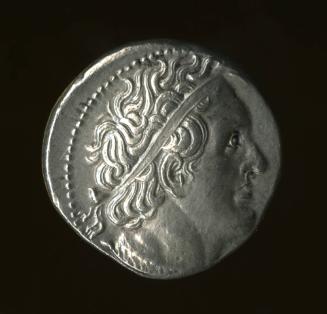
about 305-285 BCE
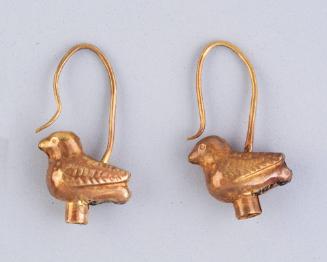
about 2nd century BCE
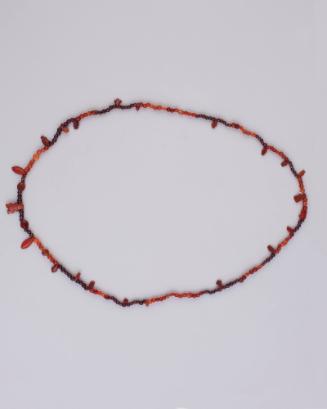
18th–19th Dynasties (1550–1189 BCE)
about 375-325 BCE

Membership
Become a TMA member today
Support TMA
Help support the TMA mission