

Bird-Shaped Earrings from the Black Sea Coast


Bird-Shaped Earrings from the Black Sea Coast
Place of OriginUkraine, reportedly Olbia (modern Parutyne)
Dateabout 2nd century BCE
DimensionsL: 1 1/8 in.
MediumGold (hollow repoussé)
ClassificationJewelry
Credit LineGift of W. P. Baker
Object number
1926.121A-B
Not on View
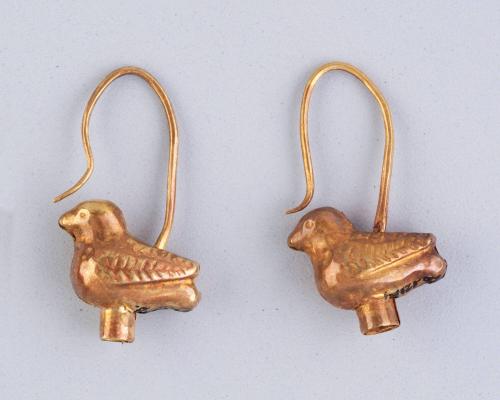
DescriptionEach earring is formed as a small, three-dimensional bird, likely a dove, perched on a cylindrical spool base. The body is hollow, constructed from two halves of gold sheet formed by repoussé and joined at the seam. The surface features modeled details indicating folded wings and tail feathers. A simple curved ear-wire is attached to the head of the bird.
Label TextThese earrings, shaped as resting doves, reportedly originate from Olbia, a prominent Greek colony located on the Bug River estuary in modern Ukraine. Established by settlers from Miletus in the 7th century B.C., Olbia became a vital "emporium" (trading post) where Greek and Scythian cultures converged. Jewelry found in this region often mirrors the cosmopolitan fashions of the Mediterranean, demonstrating the reach of Hellenistic culture. The dove motif, closely associated with Aphrodite, suggests these were worn by a woman of status to invoke the goddess of love and beauty.Published ReferencesAmerican Art Association, A Remarkable Greek Archaeological Collection from Olbia in South Russia Belonging to Mr. Joseph Chmielowski, February 25, 1922, Lot 701.
St. Petersburg Museum of Fine Arts, Infinite Riches: Jewelry Through the Ages, 1989, p. 27, cat. no. 17.
Puma, Richard Daniel de, Art In Roman Life: Villa to Grave, Rome, L'erma di Bretschneider, 2009, p. 116, no. 143, repr. (col.) fig. 70.
Exhibition HistoryCedar Rapids Museum of Art, Art in Roman Life: Villa to Grave, September 2003-August 2005.
St. Petersburg Museum of Fine Arts, Infinite Riches: Jewelry Through the Ages, 1989, no. 17, p. 27, repr.

about 220-130 BCE

2nd-1st century B.C.E.

about CE 200

2nd-1st century B.C.E.
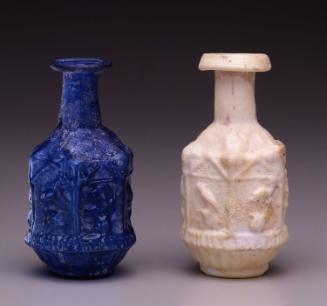
Probably second quarter of 1st century
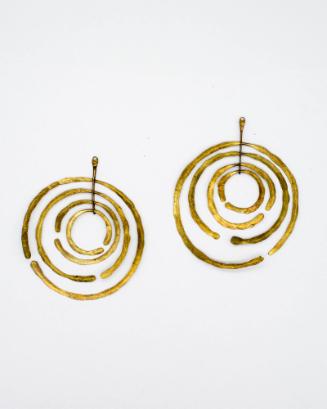


about 375-325 BCE
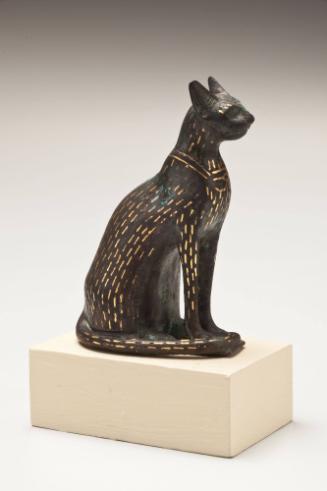
26th Dynasty (664–525 BCE), about 600 BCE

Membership
Become a TMA member today
Support TMA
Help support the TMA mission