

Oinochoe (Pitcher) in the Shape of a Woman’s Head
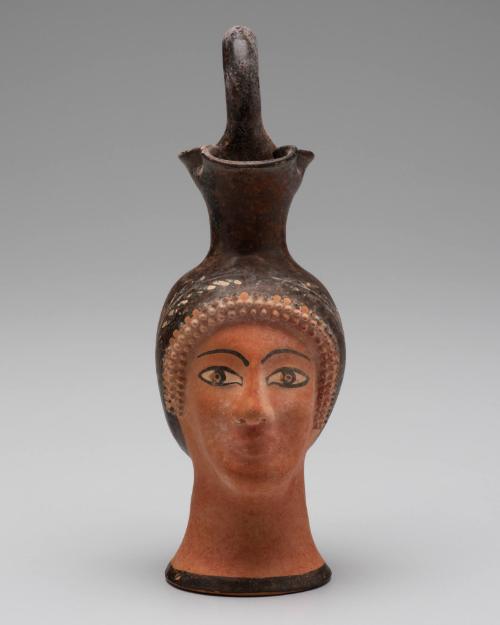


Oinochoe (Pitcher) in the Shape of a Woman’s Head
Place of OriginGreece, Athens
Date480-470 BCE
DimensionsH (to top of handle): 7 3/32 in. (18 cm); H (to lip): 5 11/16 in. (14.5 cm); Max Diam: 2 7/8 in. (7.3 cm)
MediumEarthenware with slip decoration and gilding
ClassificationCeramics
Credit LinePurchased with funds from the Libbey Endowment, Gift of Edward Drummond Libbey
Object number
1976.138
Not on View
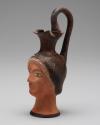
DescriptionThis mold-made terracotta vessel takes the form of a female head. The vessel's neck and trefoil mouth are wheel-thrown and attached to the top of the molded head, while a strap handle connects the back of the neck to the back of the head. The woman's face is characterized by almond-shaped eyes, a straight nose, and full lips set in a grave expression. Her hair is arranged in waves around her forehead, surmounted by a gilded acanthus leaf diadem. The skin is reserved in the color of the clay, while details of the eyes and hair are added in black and red slip.
Label TextThis vessel, known as an oinochoe, was used for pouring wine during the symposium, an ancient Greek drinking party. Molded in the shape of a woman’s head, the cup plays with the user's perception: as the drinker tilts the pitcher to pour, they are confronted by the woman's gaze. Note the unusual gilded diadem of acanthus leaves above her brow, a deluxe addition to this specific piece. Unlike standard pottery thrown on a wheel, this head was formed using molds, a technique that allowed for the mass production of complex sculptural shapes.Comparative ReferencesSee also Beazley, J.D., "Charinos," The Journal of Hellenistic Studies, London, 1929, vol. XLIX, part 1, pp. 38-78, pls. I-VI.
cf. Beazley, J.D., Attic Red-figure Vase Painters, 2nd ed., Oxford, 1963, classN: the Cook Class, vol. 2, pp. 1539-1544.
cf. Beazley, J.D., Paralipomena, Oxford, 1971, class N: The Cook Class, pp. 503-504.
cf. Biers, William R., "An Attic Head Vase," Muse, no. 7, 1973, Museum of Art and Archaeology, University of Missouri, Columbia, pp. 17-20.

500-480 BCE

Late 2nd to early 3rd century CE

Perhaps late first or 2nd century

about 450-430 BCE


Late 19th century
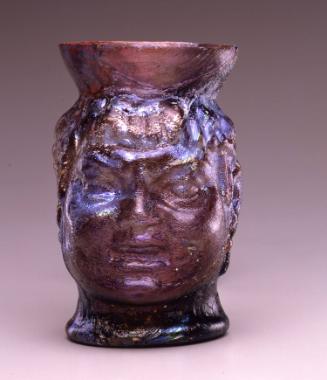
Second half of the 1st century CE


about 200 CE
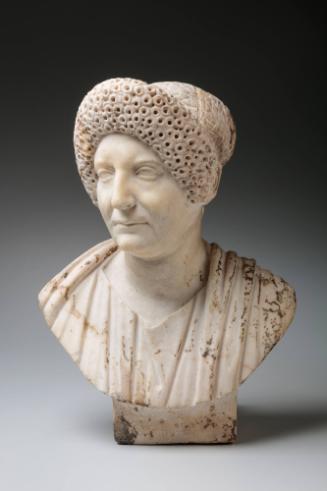
c. 90 CE

Membership
Become a TMA member today
Support TMA
Help support the TMA mission