

Bowl with Marvered White Threads

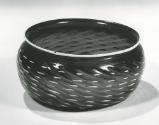
Bowl with Marvered White Threads
Place of OriginSyria, found in Damascus
Date13th century
DimensionsH: 2 3/4 in. (7 cm); Rim Diam: 5 1/8 in. (13 cm); Max Diam: 5 11/16 in. (14.5 cm)
MediumBlown and tooled glass, with applied marvered threads
ClassificationGlass
Credit LinePurchased with funds from the Libbey Endowment, Gift of Edward Drummond Libbey
Object number
1979.55
Not on View
DescriptionThis deep, varying-profile bowl is blown from manganese-purple glass that appears nearly black. The vessel features a flattened base with a central pontil mark and convex sides that are tooled with diagonal ribbing. The body is decorated with opaque white glass threads that have been applied and marvered (melted flush) into the surface; these threads are combed into a pattern of small, repeating lozenges or "pulls" across the ribbed body. A solid opaque white trail accents the plain, straight rim. The vessel is intact and noted for its exceptional preservation, attributed to its reported discovery inside a protective terracotta container.
Label TextThis bowl appears black at first glance, but held to the light, it reveals a deep, translucent purple hue created by manganese. The potter-like shape and the combed white pattern—embedded flush into the glass—are characteristic of high-quality Syrian tableware from the medieval period. Its survival in such pristine condition is due to an ancient storage solution: it was reportedly found inside a sturdy terracotta pot which shielded it from the weight of the earth for centuries. The object has a significant publication history. It was first published by Gustavus Eisen in 1927, who erroneously classified it as Roman (Augustan). It later entered the collection of Fahim Kouchakji, a major dealer of Islamic art, who provided the specific provenance of Damascus. Correspondence in the museum archives reveals that the bowl was originally found nested inside a "footed goblet or chalice of plain tan terra cotta," which acted as a protective capsule. Regrettably, this ceramic outer vessel was discarded by a subsequent owner, Mrs. Constable-Maxwell, who found it "unattractive".Published ReferencesEisen, Gustavus A., Glass, its Origin, History, Chronology, Technic and Classification to the Sixteenth Century, vol. 1, New York, W.E. Rudge, 1927, p. 163, pl. 35c; p. 207.
Sotheby Parke Bernet & Co., The Constable-Maxwell Collection of Ancient Glass, London, Sotheby Parke Bernet & Co., 1979, pp. 200–01, lot 354.
"Recent important acquisitions," Journal of Glass Studies, vol. 22, 1980, p. 90 (repr.).
Detroit Institute of Arts, Mamluk Art in Regional Collections, Detroit, 1982, no. 18.

5th Century

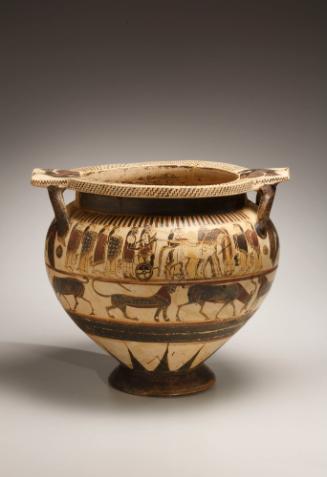
Unidentified, Gorgoneion Group
about 560 BCE
probably 19th century
19th century
1st-2nd century CE
Late 1st century BCE to early 1st century CE

4th-5th century CE
1st century CE
about 325-250 BCE
Late 1st century BCE to early 1st century CE

Membership
Become a TMA member today
Support TMA
Help support the TMA mission