

Icon with The Fiery Ascension of the Holy Prophet Elijah
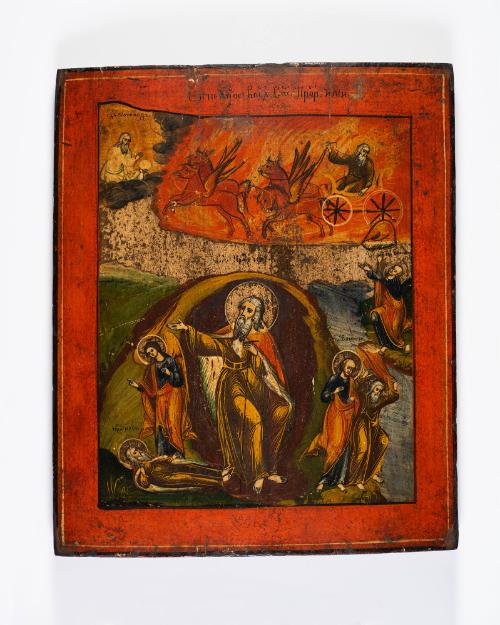

Icon with The Fiery Ascension of the Holy Prophet Elijah
Place of OriginRussia
Date19th Century (?)
DimensionsTop: 11 1/2 in. (29.2 mm); Bottom: 11 3/4 in. (29.9 mm); PR: 14 1/8 in. (35.9 mm); PL: 14 1/4 in. (36.2 mm)
MediumGesso on panel, pigment.
ClassificationPaintings
Credit LineGift of the Popplestone Family
Object number
2006.117
Not on View
DescriptionA Russian Orthodox icon depicting the Fiery Ascension of the Prophet Elijah in a continuous narrative style. The composition is arranged in multiple registers featuring four key episodes from the Elijah cycle:
Main Register (Top): Elijah ascends to heaven in a chariot of fire drawn by winged horses. To the right, Elisha catches Elijah’s falling mantle. In the upper left corner, God the Father (inscribed as Lord Sabaoth) blesses the event from a cloud mandorla.
Central Register: Elijah sits within a stylized cave in the wilderness, fed bread by a raven (1 Kings 17:6).
Lower Left: An angel wakes the sleeping Elijah under a bush (1 Kings 19:5–7).
Lower Right: Elijah and Elisha stand at the banks of the Jordan River; Elijah prepares to strike the waters with his mantle (2 Kings 2:8).
The panel features a red background and borders, characteristic of Northern Russian provincial workshops.
Label TextThis panel functions like a graphic novel, compressing four events from the life of the Prophet Elijah into a single landscape. At the center, Elijah retreats to the wilderness, where a raven sustains him with bread. Below, an angel wakes the exhausted prophet to continue his journey. The story culminates at the top: Elijah ascends to heaven in a chariot of fire, dropping his mantle—and his prophetic authority—to his successor, Elisha. The vivid red background identifies this as a "Northern" icon, created in a village workshop rather than an imperial studio.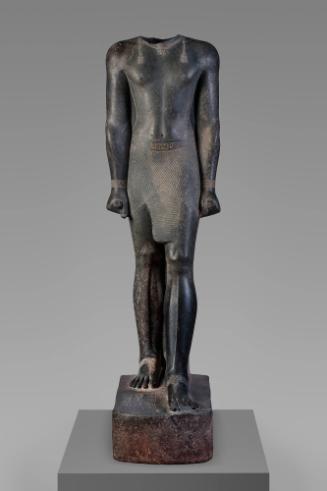

Ptolemaic Period (332–30 BCE), about 246–222 BCE
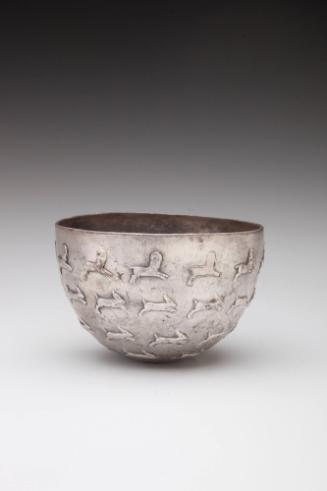
about 550-400 BCE

about 230 BCE- 220 CE

2nd-1st century BCE


3rd to 1st century BCE

mid-19th century

18th Dynasty (1550-1292 BCE), about 1390 BCE

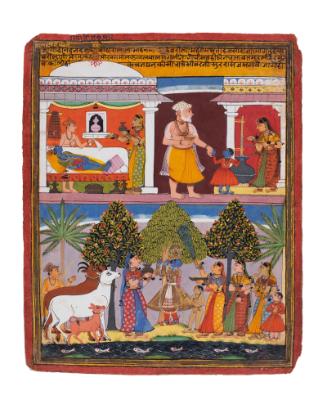
Mewar School, attributed to Manohar
about 1655-1660

about 1350

Membership
Become a TMA member today
Support TMA
Help support the TMA mission