

Temple Relief with Ptolemy III Euergetes

Temple Relief with Ptolemy III Euergetes
Place of OriginEgypt, reportedly from the Temple of Khonsu at Karnak, near Luxor
DatePtolemaic Period (332–30 BCE), about 246–222 BCE
Dimensions17 7/8 × 15 1/4 × 1 1/2 in. (45.4 × 38.7 × 3.8 cm)
MediumSandstone with paint
ClassificationSculpture
Credit LinePurchased with funds from the Libbey Endowment, Gift of Edward Drummond Libbey
Object number
1972.17
On View
Toledo Museum of Art (2445 Monroe Street), Gallery, 02, Classic
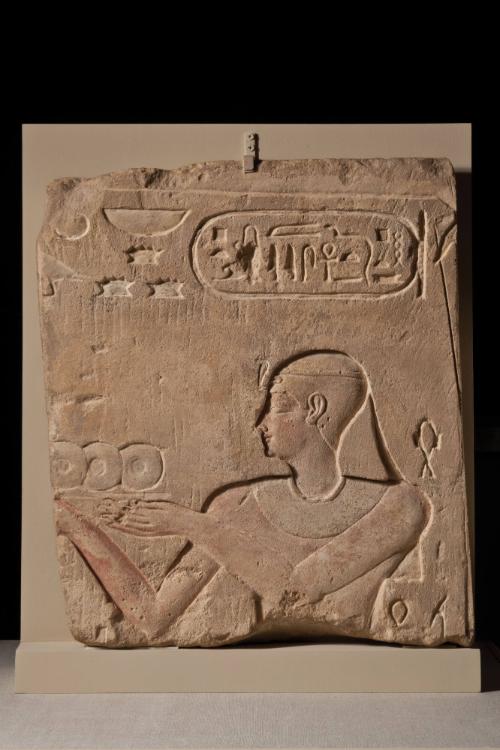
DescriptionA rectangular fragment of a sandstone relief carving, executed in sunk relief (en creux). The scene depicts the upper body and head of a male royal figure in profile facing left. The figure wears a seshed diadem (headband) with a uraeus cobra at the forehead. He wears a broad collar necklace. His arms are raised, holding a flat tray upon which rest three circular objects, likely rings of gold. Above the figure is a large horizontal cartouche containing hieroglyphs, flanked by a vertical text column to the right and a Sa (protection) amulet symbol behind the king's head. Traces of red and blue pigment remain on the surface.
Label TextOnce part of a temple wall, this relief carving presents a typically Egyptian combination of image and text, royalty and piety. The Pharaoh offers heavy gold rings to a god, whose image would have been at the left. He is rendered in an Egyptian style invented around 3000 BCE: the eye and shoulders of the king are depicted from the front, the arms and head in profile. Inscribed above him is a large horizontal loop of rope—a cartouche—that surrounds, designates, and protects one of the king’s names. To the right of the king’s head is a hieroglyph meaning “protection.”Published ReferencesMunzen und Medaillen, Apr. 28, 1972, lot 128, repr. (sales cat.).
"Recent accessions..." Art Quarterly, vol. 37, no. 1, Spring 1974, p. 98.
"La Chronique des Arts," Gazette des Beaux-Arts, vol. 81, no. 1249, repr. p. 102.
Jucker, Ines. "Zum Bildnis Ptolemaios' III. Euergetes I." Antike Kunst, vol. 18, no. 1 (1975), p. 18.
"Treasures for Toledo," Toledo Museum of Art Museum News, 1976, vol. 19, nos. 2-3, p. 45.
Peck, William H., Sandra E. Knudsen and Paula Reich, Egypt in Toledo: The Ancient Egyptian Collection at the Toledo Museum of Art, Toledo, Toledo Museum of Art, 2011, p. 88-89, repr. (col.) p. 89, (det.) p. 87.
Exhibition HistoryToledo Museum of Art, The Mummies: From Egypt to Toledo, February 3- May 6, 2018.Comparative ReferencesSee also Dümichen, Johannes, Altägyptische Tempelinschriften, Leipzig, 1867, pl. 89.cf. Dümichen, Johannes, "Bauurkunde der Tempelanlagen von Edfu," Zeitschrift für Agyptische Sprache und Alterthumskunde, Leipzig, 1870, no. 8, pp. 1 ff. and pl. I ff.
cf. Dümichen, Johannes, "Die sale und Zimmer im Tempel von Dendera," Zeitschrift für Agyptische Sprache und Alterthumskunde, Leipzig, 1869, p. 102.
cf. Jéquier, G., Les Temples Ptolemaiques et Romains, 1924, p. 6ff.
cf. Michalowski, Karnak, 1970, p. 80ff.
early 12th century
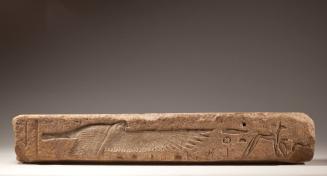
21st–31st Dynasties (1069–332 BCE) or Ptolemaic Period (332–30 BCE)

Unidentified
26th Dynasty (664–525 BCE), about 570-527 BCE

Shunga Dynasty (185-75 BCE)

Gupta Period (320-647), about 600
4th Dynasty (2613–2498 BCE)

4th Dynasty (2613–2498 BCE)

Membership
Become a TMA member today
Support TMA
Help support the TMA mission