

White-Ground Alabastron with Javelin and Discus Throwers
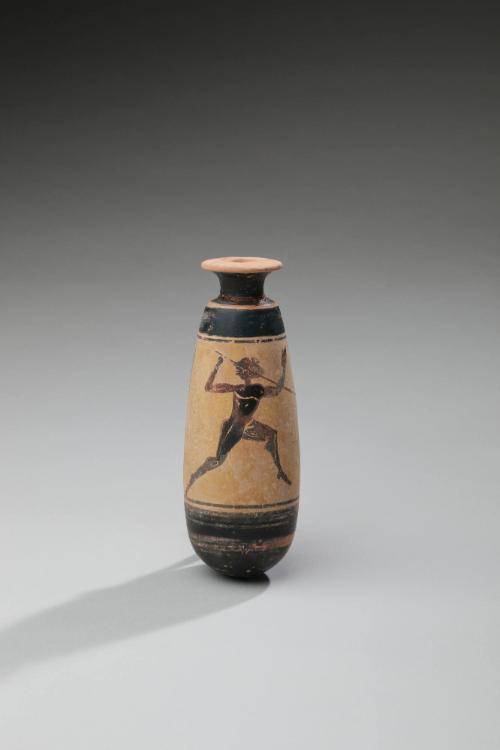


White-Ground Alabastron with Javelin and Discus Throwers
Place of OriginGreece, probably Athens
Dateabout 500 BCE
DimensionsH: 4 3/8 in. (11.1 cm); W: 1 1/2 in. (3.8 cm); Rim Diam: 1 1/8 in. (2.7 cm)
MediumEarthenware with white-ground slip and black-figure decoration
ClassificationCeramics
Credit LineGift of the Popplestone Family
Object number
2006.86
Not on View
DescriptionA small, cylindrical pottery vessel with a rounded bottom, narrow neck, and flat, disc-shaped rim. The body is coated in a white slip, while the neck, rim, and handle are glazed black. The decoration is executed in the black-figure technique with incised details. The primary scene features three male figures arranged around the body of the vessel. Two are nude athletes: one holding a javelin (lance) and the other a discus. The third figure is a trainer or musician wearing a long himation (cloak) and playing a double-flute (aulos). The figures are depicted in silhouette against the white background. There is a "net" or lattice pattern on the shoulder and neck area.
Label TextThis small oil flask, called an alabastron, was used by ancient Greek athletes to carry scented oil for use after training or competition. Painted around 500 BCE in Athens, the vessel shows two nude athletes—one with a javelin, the other with a discus—being supervised by a clothed trainer. Their activity reflects the importance of athletics in Greek society, where physical fitness was linked to virtue and civic duty. The imagery also signals the object’s practical role in the gymnasium.Published ReferencesAncient World Arts Collection A899, Litchfield, CT, 1999, no. A384.


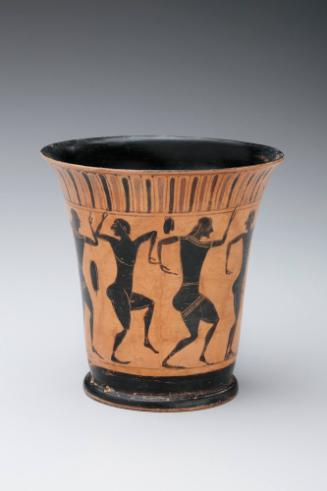
about 540 BCE


Late 6th- early 7th century CE

Membership
Become a TMA member today
Support TMA
Help support the TMA mission