

Beaker (Kalathos) with Dancing Komasts
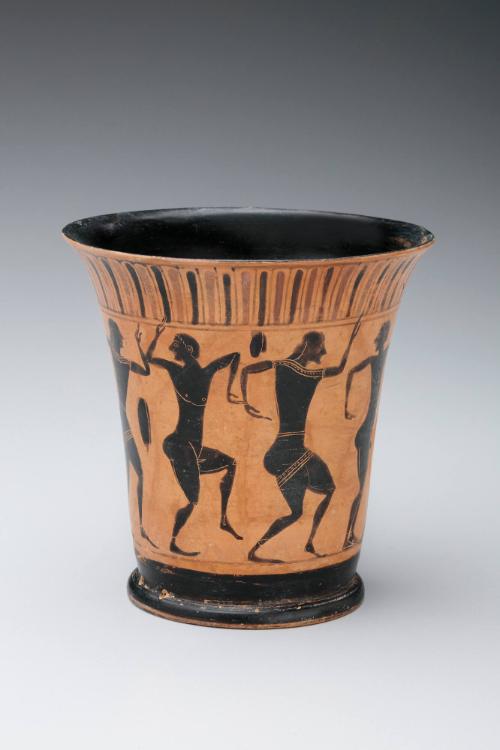

Beaker (Kalathos) with Dancing Komasts
Place of OriginGreece, Athens
Dateabout 540 BCE
DimensionsH: 4 1/8 in. (10.5 cm); Diam (lip): 4 3/32 in. (10.4 cm); Diam (foot): 2 21/32 in. (6.7 cm)
MediumWheel-thrown, slip-decorated earthenware with incised details
ClassificationCeramics
Credit LinePurchased with funds from the Libbey Endowment, Gift of Edward Drummond Libbey
Object number
1967.134
Not on View
DescriptionA ceramic vessel of the shape conventionally known as a kalathos or beaker, featuring a flaring lip and a convexly curved foot. The interior is glazed black. The exterior features a frieze set between a black band below and a tongue pattern (alternating black and red) at the rim. The primary decoration depicts a procession of eight figures—four nude youths and four women wearing short, belted tunics (peploi)—dancing to the right. The genders alternate, and the figures display varied arm positions; most hold the left arm up and right down. One youth is ithyphallic. Three youths and one woman look backward. Folded garments hang in the field between the figures. The faces of the women, which appear matte, were likely originally covered in added white which has since worn away. The foot features two holes pierced through the clay; the CVA states these were bored at the time of manufacture, potentially for suspension, though internal files debate if they are ancient repair holes. A graffito (resembling "II") appears on the reserved underside of the foot.
Label TextThis rare cup shape, known as a kalathos or beaker, was likely used for drinking wine during the symposium (drinking party). The scene depicts a komos, a lively ritual procession of revelers. Four nude male youths and four women wearing short tunics dance rhythmically in a line, gesturing with their arms. The hanging folded garments in the background suggest an indoor setting or perhaps the disrobing associated with the event. While the black glaze silhouette style is typical of Athens, the shape is unusual; only a few similar black-figure beakers exist, including examples in the Louvre and the Metropolitan Museum of Art. The two holes in the foot were likely made before the clay was fired, possibly to allow the cup to be suspended by a cord when not in use.Published ReferencesMünzen and Medaillen A.G., Auktion 43. Kunstwerke der Antike. 6. Mai 1967. Basel, pp. 62-63, lot no. 126.
Riefstahl, Rudolph M., "Greek Vases," Toledo Museum of Art Museum News, vol. 11, no. 2, 1968, p. 33.
"Accessions of American and Canadian Museums," Art Quarterly, vol. 31, no. 2, 1968, p. 205.
Riefstahl, Rudolph M., "Treasures for Toledo," Toledo Museum of Art Museum News, vol. 12, no. 4, 1969, p. 90.
Sparkes, Brian and Lucy Talcott, The Athenian Agora XII: Black and Plain Pottery, vol. XII, Princeton, 1970, p. 80.
Luckner, Kurt T., "Greek Vases: Shapes and Uses," Toledo Museum of Art Museum News, vol. 15, no.3, 1972, p. 79.
Boulter, Cedric G., and Kurt T. Luckner, Corpus vasorum antiquorum: Toledo Museum of Art, U.S.A. Fasc. 17, Toledo, 1976, p. 23, repr. pl. 33, profile drawing fig.6.
Oakley, John H., Attic Red-Figure Beakers: Special Vases for the Thracian Market, Offprint from Antike Kunst, v. 52, 2009, p. 67, 74, pl. 9,2.
Smith, Tyler Jo, Komast Dancers in Archaic Greek Art, New York, Oxford University Press, 2010, p. 92, 107, pl. 23B, p. 330.
Exhibition HistoryToledo Museum of Art, In Motion: Dance and Performance in Art, September 18, 2015- January 3, 2016.

6th century BCE
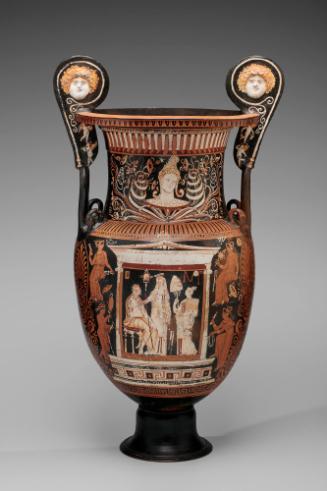
about 350-325 BCE
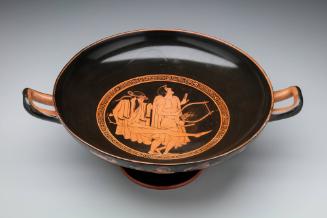


about 300 BCE
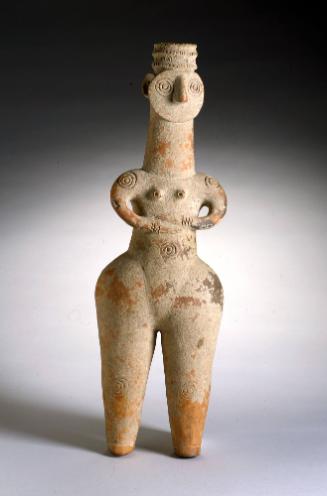
Early 1st millennium BCE
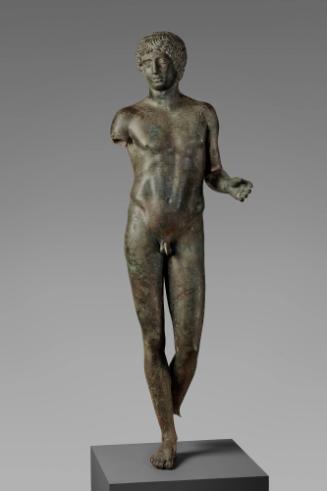
mid-2nd to early 3rd century CE (Severan?)

Membership
Become a TMA member today
Support TMA
Help support the TMA mission