

Akan Gold Weight: Two Men and a Vase
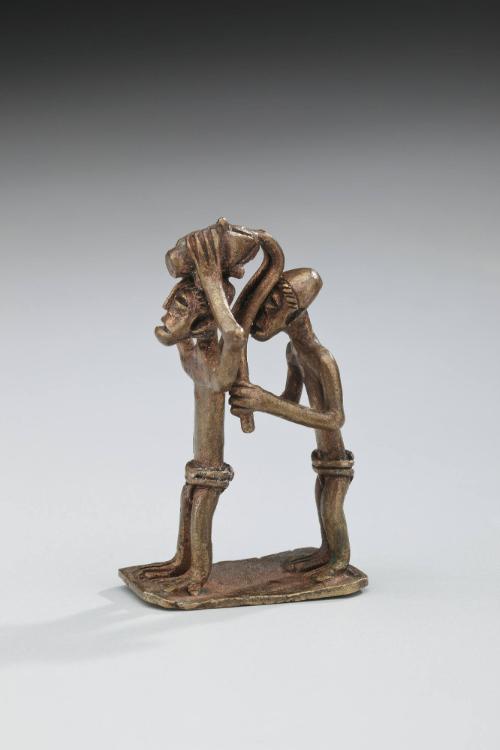

Akan Gold Weight: Two Men and a Vase
Place of OriginGhana
DateEarly to mid-20th century
DimensionsH: 2 1/2 in. (6.4 cm); L: 1 9/16 in. (4 cm); W: 1 1/8 in. (2.9 cm); Weight: 57.91 grams
MediumBrass.
ClassificationMetalwork
Credit LineGift of the Popplestone Family
Object number
2006.77
Not on View
DescriptionA small, figurative sculpture cast in brass. Two stylized male figures stand on a rectangular base, facing one another. Between them sits a large, rounded vessel or vase with a narrow neck. One figure reaches toward the vessel while the other appears to be steadying it or gesturing toward the liquid within. The figures have simplified, columnar limbs and expressive facial features characteristic of Akan metalwork. A partial museum label remains adhered to the center of the base.
Label TextGold was the basis of Ashanti prosperity from the 14th through the 19th centuries. Miniature sculptures served as weights to measure gold dust on balance scales. Each trader, chief, and family head kept a small bag filled with his own weights, both for verifying accuracy and for the pleasure of assembling “exhibitions” of tiny sculptures as part of each bargain. Ashanti art often incorporates messages and proverbs. The meaning of the sculpture of two human figures is not yet certain, but it might be “A blind man does not show the way to a blind man.”Published ReferencesUnpublished.
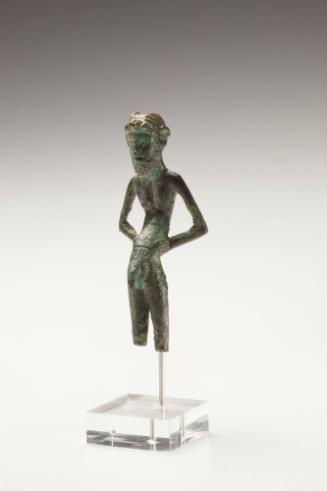
Ptolemaic Period (332–30 BCE), about 200–50 BCE
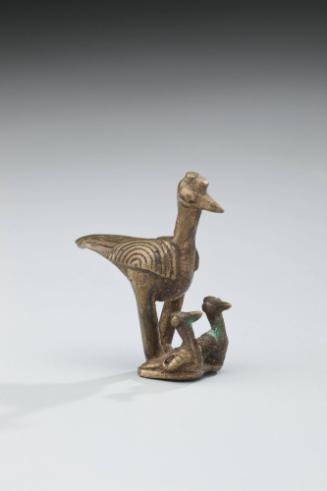
Early to mid-20th century

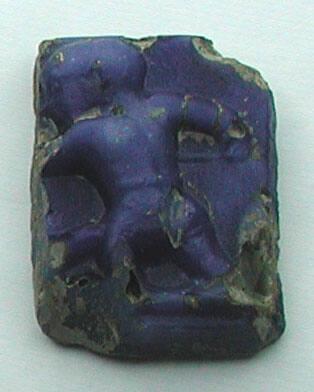
1st century BCE - 2nd century CE



about 230 BCE- 220 CE

Late 3rd to mid-4th century CE


Membership
Become a TMA member today
Support TMA
Help support the TMA mission