

Unguent Bottle (Krateriskos)
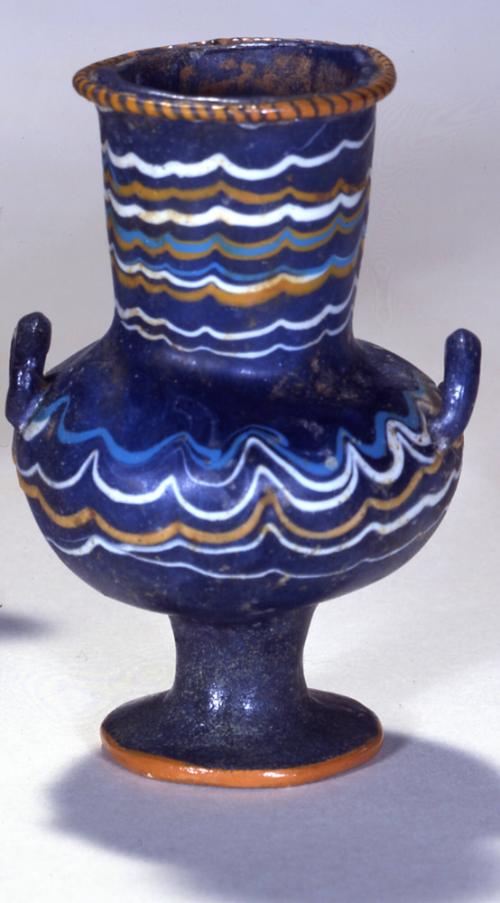


Unguent Bottle (Krateriskos)
Place of OriginEgypt
Dateabout 1400-1350 BCE
DimensionsH: 3 3/16 in. (9.7 cm); Rim Diam: 1 3/4 in. (4.4 cm); Body Diam: 2 7/16 in. (6.6 cm); Base Diam: 1 9/16 in. (4 cm)
MediumCore-formed; applied handles and foot; applied marvered and unmarvered threads.
ClassificationGlass
Object number
1935.55
Not on View
DescriptionThis is a two-handled krateriskos formed on a core. The vessel features a dark blue ground with applied decoration in opaque white, opaque yellow (which appears orange), and opaque turquoise-blue. The rim is short and horizontal, sloping slightly outward with a rounded edge, leading to a tall, cylindrical neck that tapers downward. The neck joins the rounded shoulder at an obtuse angle, transitioning into a squat, bulbous body. The foot is tall, outsplayed, and dark blue, with a concave underside and rounded edge. Two vertical dark blue loop handles are applied to the shoulder. Decoration includes a twisted cord of yellow and blue threads at the rim, marvered festoon patterns of white and yellow on the neck and body, and single turquoise threads applied in festoons at the middle of the neck and on the shoulder. A yellow thread encircles the edge of the foot.
Label TextThis vibrant vessel, known as a krateriskos (little mixing bowl), mimics the shape of large ceramic wine jars used at Greek feasts, but on a miniature scale. In ancient Egypt, however, this shape was used strictly for holding precious perfumed oils or cosmetics. Created over 3,000 years ago during the opulent 18th Dynasty, likely under the reign of Amenhotep III or Akhenaten, it demonstrates the high technical skill of early glassmakers. They wound molten glass threads around a clay core, then "marvered" (rolled) the surface smooth to create the distinctive festoon patterns. The deep blue glass was prized for its resemblance to lapis lazuli, a stone associated with the night sky and rebirth.Published ReferencesLabino, Dominick, Visual Art in Glass, Dubuque, Iowa, 1968, pp. 12-13, fig. 1.
Nolte, Birgit, Die Glasgefasse im alten Aegypten, Munchner Aegyptologische Studien, no. 14, Berlin, 1968, pp. 89-90 and 94, no. 21, pl. 8.
Gunther, Charles F., "How Glass is Made," Toledo Museum of Art Museum News 15, no. 1, 1972, p. 14.
"Art in Glass," The Glass Industry 51, July 1970, p. 315, ill.
D.-L. Jones, "The Toledo Museum's New Glass Gallery," The Glass Club 93/94, March-June 1970, p. 10, ill.
Wittmann, Otto, ed., The Toledo Museum of Art. A Guide to the Collections, Toledo, Ohio, 1976, p. 7, fig. 6.
Grose, David F., "Ancient Glass," Toledo Museum of Art Museum News 20, no. 3, 1978, pp. 68, 70-71, fig. 2.
Grose, David F., "The Origins of Early History of Glass, in The History of Glass, eds. Dan Klein and Ward Lloyd, London, 1984, p. 15, ill.
Grose, David F., "Innovation and Change in Ancient Technologies: The Anomalous Case of the Roman Glass Industry," High-technology Ceramics: Past, Present, and Future, pp. 65-79, Ceramics and Civilization, vol. 3, Westerville, Ohio, 1986, pp. 66-67, fig. 1.
Grose, David F., "Innovation and change in ancient technologies: The anomalous case of the Roman glass industry," in High-technology Ceramics, Westerville, OH, 1986, p. 1, fig. 67.
Grose, David F., Early Ancient Glass: Core-formed, Rod-Formed, and Cast Vessels and Objects from the Late Bronze Age to the Early Roman Empire, 1600 B.c. to A.d. 50, New York, Hudson Hills Press in association with the Toledo Museum of Art, 1989, Cat. No. 8, p. 61, repr. (col.) p. 41, drawing, p. 397.
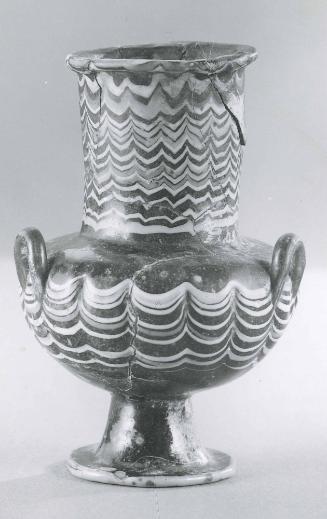
18th Dynasty (1550-1292 BCE), about 1412-1350 BCE

18th Dynasty (1550-1292 BCE), about 1400-1350 BCE
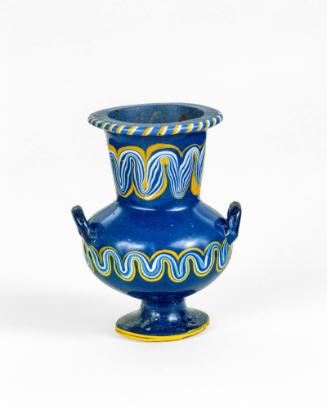

18th Dynasty (1550-1292 BCE), about 1400-1350 BCE
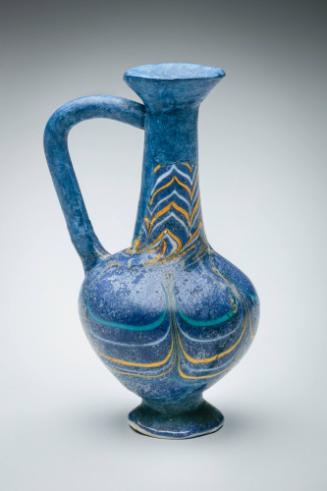
18th Dynasty (1550-1292 BCE), about 1400-1350 BCE

Late 6th through 5th century BCE
Late 6th through 5th century BCE
2nd through mid-1st century BCE

about 1350-1300 BCE
Late 6th through 5th century BCE

Mid-4th through early 3rd century BCE

Membership
Become a TMA member today
Support TMA
Help support the TMA mission