

Unguent Bottle (Hydriske)
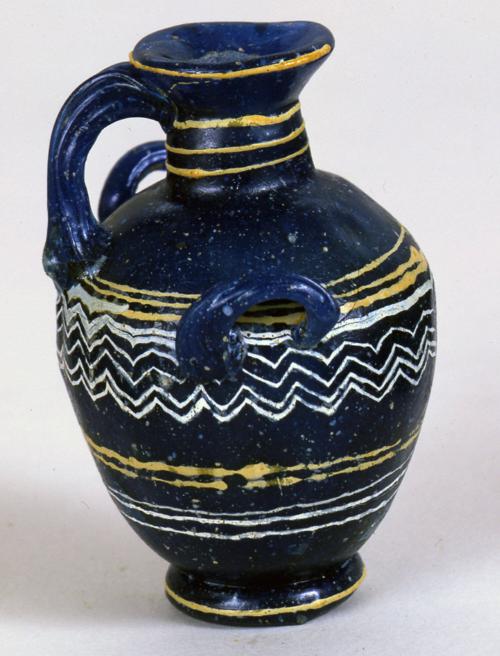

Unguent Bottle (Hydriske)
Place of OriginEastern Mediterranean or Italy
DateMid-4th to early 3rd century BCE
DimensionsH: 3 3/8 in. (8.4 cm); Rim Diam: 1 3/16 in. (3.0 cm); Max Diam (body): 2 1/4 in. (5.6 cm); Base Diam: 1 3/16 in. (3.0 cm)
MediumCore-formed glass; applied rim-disk, handles, and padbase; applied marvered and unmarvered threads.
ClassificationGlass
Credit LinePurchased with funds from the Libbey Endowment, Gift of Edward Drummond Libbey
Object number
1983.13
Not on View
DescriptionA miniature vessel in the form of a hydria (water jar). The body is opaque cobalt-blue glass with applied decoration in opaque yellow and white. The vessel features a moderately broad rim-disk sloping inward, a cylindrical neck tapering upward, and a bulbous body resting on a circular cobalt-blue pad-base. Three handles are applied in blue glass: two vertical loop handles on the shoulder and one vertical strap handle rising from shoulder to neck. Decoration consists of an unmarvered yellow thread spiraling the neck and pad-base, and marvered threads on the body forming horizontal lines and a central zigzag pattern in white. The surface shows some pitting and strain cracking.
Published ReferencesGrose, David F., Early Ancient Glass: Core-formed, Rod-Formed, and Cast Vessels and Objects from the Late Bronze Age to the Early Roman Empire, 1600 B.c. to A.d. 50, New York, Hudson Hills Press in association with the Toledo Museum of Art, 1989, Cat. No. 157, p. 165-166, Repr. (col.) p. 105.
Late 6th through 5th century BCE

Late 6th through 5th century BCE
2nd through mid-1st century BCE
Late 6th through 5th century BCE

Mid-4th through early 3rd century BCE

Late 6th to early 5th century BCE

Mid-4th through early 3rd century BCE
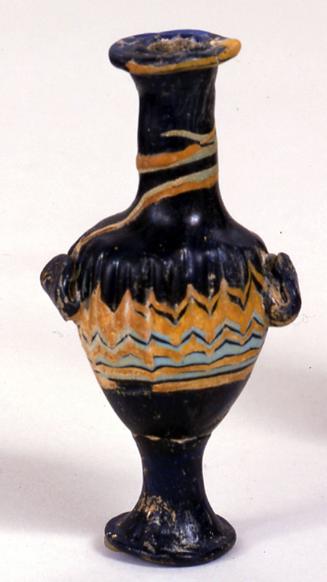
3rd century BCE
2nd through mid-1st century BCE

3rd century BCE
3rd through 2nd century BCE

Membership
Become a TMA member today
Support TMA
Help support the TMA mission