

Loculus Relief with Portrait of Umm'abi
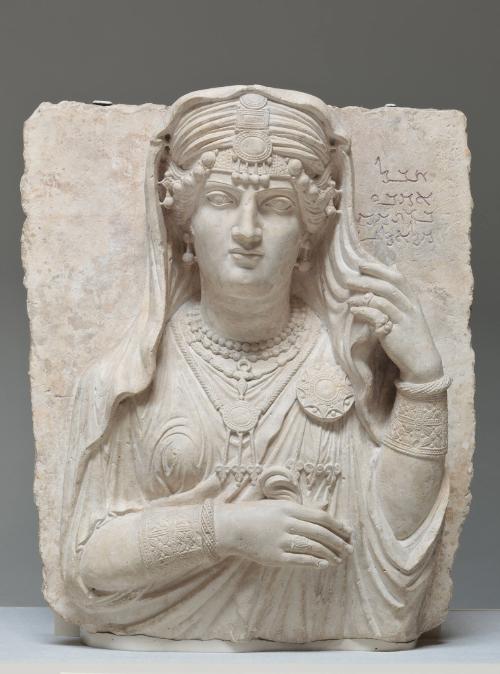


Loculus Relief with Portrait of Umm'abi
Place of OriginSyria, from Palmyra (modern Tadmor)
Dateabout 200 CE
Dimensions23 x 19 in. (58.4 x 48.3 cm)
MediumLimestone with traces of pigment.
ClassificationSculpture
Credit LinePurchased with funds from the Libbey Endowment, Gift of Edward Drummond Libbey
Object number
1962.18
On View
Toledo Museum of Art (2445 Monroe Street), Gallery, 02, Classic
DescriptionA high-relief, rectangular limestone bust of a woman facing forward. She wears a tunic and a himation (cloak) which is fastened on her left shoulder with a circular brooch and draped over her head as a veil. Her right hand is raised to hold the edge of the veil near her cheek, while her left arm crosses her body to hold a fold of the garment. She wears an ornate, high turban with a central floral motif and a diadem band. Her jewelry is extensive, including a chain with cabochon gems looped over her forehead, temple pendants, dumbbell-shaped earrings, four distinct necklaces (including a choker and a long chain with a crescent pendant), broad cuff-style armlets with panel decoration, and twisted spiral bracelets. An Aramaic inscription is carved into the upper left corner. Traces of red, blue, green, yellow, and black pigment are visible on the jewelry, eyes, and inscription.
Label TextHundreds of portraits survive from Palmyra. Most are sculpted stone slabs used to seal graves cut into the walls of the tombs of wealthy merchant families. The linear style of carving and the clothing and jewelry reflect local fashions rather than those of cities around the Mediterranean Sea. Umm’abi wears a tunic under a cloak and on her head a turban and a floor-length veil. Her lavish jewelry includes a diadem, four necklaces, a brooch with ivy-leaf pendants, rings, cuff armlets, and spiral bracelets. The sculpture was once painted: traces of red, blue, green, and yellow pigment can be seen on the jewels.Published ReferencesMackay, Dorothy, "The Jewellery of Palmyra and its Significance," Iraq, vol. 11, 1949, pp. 160-187, pl. LX, 1, "Ummabi (by kindness of Abbe J. Starcky)" drawing of armlet p. 177, fig. 6a.
Sotheby's 217th Season, London, 1961, p. 50, repr.
"Cronache-Londra; Sculpture Antiche all'Arcade Gallery," Emporium, Revista Mensile D'Arte e di Culture, December 1961, no. 804, p. 284, repr.
"New Accessions," Toledo Museum of Art Museum News, new series, vol. 7, no. 4, Winter 1964, repr. p. 81.
Frankfurter, Alfred, "Museum Evaluations, 2: Toledo," Art News, vol. 63, no. 9, January 1965, pp. 24-27, 52-56, repr. p. 25.
"New Accessions U.S.A.," Gazette des Beaux-Arts, vol. 65, no. 1153, February 1965, no. 130, p. 29, repr.
Spaeth, Eloise, American Art Museums, New York, 1969, rev. ed., p. 205.
Toledo Museum of Art, A Guide to the Collection, Toledo, 1966, repr.
Hoke, Victoria, "Portrait of Ummabi," Toledo Museum of Art Museum News, new series, vol. 17, no. 3, 1974, pp. 51-53, repr. p. 52.
Vermeule, Cornelius, Greek and Roman Sculpture in America, Berkeley, 1981, p. 380-381, repr. p. 281.
Levy, Virginia, Let's go to the art museum, Pompano Beach, Fl., 1983, repr. p. 22.
Toledo Museum of Art, Toledo Museum of Art Masterworks, Toledo, 2009, p. 97, repr. (col.).
Krag, Signe, Funerary Representations of Palmyrene Women From the First Century BC to the Third Century AD in Studies in Classical Archaeology, vol. 3, Turnhout, Brepols, 2018, 42 n. 153 n. 156, 53 n. 259, 54 n. 262, 56 n. 291, 59 ns 316-17, 61 n. 336, 106 n. 98, 108 n. 125, 110 n. 141, 354, cat. no. 720.
Bobou, Olympia, Amy Miranda, Rubina Raja, and Jean-Baptiste Yon (eds.), The Ingholt Archive: The Palmyrene Material, Transcribed with Commentary and Bibliography, Volume Three, Brepols, 2023, 1430, no. PS 1385.
Exhibition HistoryLondon, Arcade Gallery, 1961, repr. in catalogue.Toledo, The Toledo Museum of Art, Treaures for Toledo, Dec. 1964 and Jan. 1965.
Worcester, Worcester Art Museum; Cleveland, Cleveland Museum of Art; Baltimore, Baltimore Museum of Art, Antioch: the lost ancient city, 2000-2001, no. 10, p. 122, repr. (col.).
Comparative ReferencesSee also Bossert, H.T., Altsyrien, Tubingen, 1951, p. 169, no. 549 (female funerary bust in Istamboul Museum).See also Champdor, A., Les Ruines de Palmyre, Paris, 1953, pp. 26, 27, 41, 41, 57, 91, 107, (illustrations of several comparable busts).
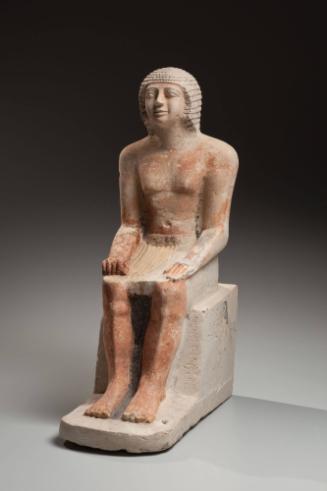
6th Dynasty (2345-2181 BCE)
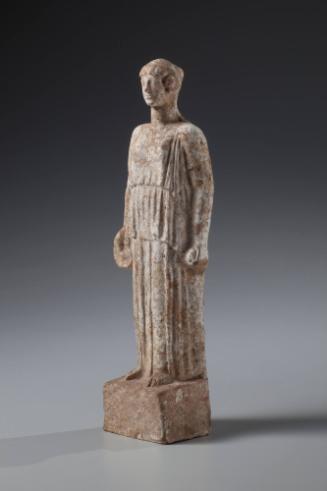
mid-5th century BCE
late 19th-early 20th century


6th-7th Century

325-300 BCE
Late 16th-13th century BCE
![Sans titre [Untitled]](/internal/media/dispatcher/81737/thumbnail)
about 1956-1959 (printed 2016)
18th Dynasty (1550-1292 BCE), about 1397-1360 BCE

19th century?

Membership
Become a TMA member today
Support TMA
Help support the TMA mission