

Skyphos with Deeds of Theseus (Prokrustes and Skiron)
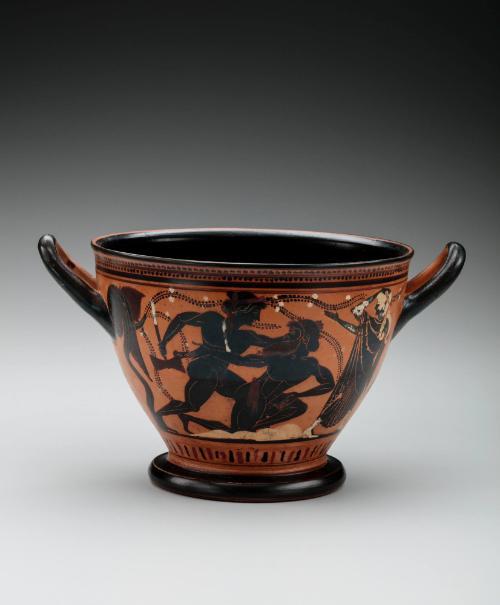




Skyphos with Deeds of Theseus (Prokrustes and Skiron)
Artist
Theseus Painter
(Greek)
Place of OriginGreece, Attica
Dateabout 490 BCE
DimensionsH (max) 6 9/16 × W (max) 11 11/16 × Diam (base) 5 1/2 × Diam (lip) 8 7/8 in. (16.7 × 29.7 × 14 × 22.5 cm)
MediumBlack Figure; Wheel-thrown, slip-decorated earthenware with incised details
ClassificationCeramics
Credit LinePurchased with funds from the Libbey Endowment, Gift of Edward Drummond Libbey
Object number
1963.27
On View
Toledo Museum of Art (2445 Monroe Street), Gallery, 02, Classic
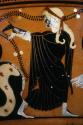
DescriptionA large, deep-bowled earthenware skyphos with two horizontal handles and a heavy torus foot, decorated in the black-figure technique with added red and white details. Beneath each handle is a large white heron, the diagnostic feature of the "White Heron Class." Side A: The hero Theseus attacks the bandit Prokrustes ("The Stretcher"). Theseus, nude but for a hairband, wields a double axe (pelekys) in one hand and seizes the bearded, collapsing Prokrustes by the head with the other. Prokrustes's white mantle lies on the ground; Theseus's mantle hangs from the branch of a spreading tree in the background. A female figure flees to the right, gesturing in alarm. Side B: Theseus attacks the bandit Skiron. The hero grabs the bearded Skiron by the leg to hurl him from a cliff. Skiron raises his hands in defense. Coiled on the rock beneath them is a large, spotted snake (an unusual variation of the canonical turtle). A tree with a hanging mantle frames the left, and a female onlooker stands to the right.
Label TextThis wine cup (skyphos) illustrates two early adventures of Theseus, the legendary king of Athens. On the front, he wields a double axe to punish Prokrustes, a bandit who forced travelers to fit his iron bed by stretching or severing their limbs. On the back, he hurls the bandit Skiron from a cliff. Note the white herons painted beneath the handles—a trademark signature of this specific artist, known to archaeologists as the "Theseus Painter." Produced shortly after the establishment of Athenian democracy (508 B.C.), such images helped transform Theseus from a minor figure into a national symbol of unity and justice, serving as a distinctively Athenian counterweight to the aristocratic hero Herakles.Published ReferencesMünzen and Medaillen A.G., Auktion XXVI, Kunstwerke der Antike. Basel. 5. Oct. 1963, p. 59, lot. no. 114.
"New Accessions," Toledo Museum of Art Museum News, vol. 7, no. 4, 1964, p. 79.
Riefstahl, Rudolph M., "Greek Vases," Toledo Museum of Art Museum News, vol. 11, no. 2, 1968, p. 39.
Beazley, John D., Paralipomena, Oxford, 1971, p. 257 (where the subject of Side B is described incorrectly as Sinis).
Luckner, Kurt T., "Greek Vases: Shapes and Uses," Toledo Museum of Art Museum News, vol. 15, no. 3, cover.
Brommer, Frank, Vasenlisten zur griechischen Heldensage, 3rd ed., Marburg, 1973, p. 245, no. 7, p. 249–250, no. 4.
Boardman, John, Athenian Black Figure Vases, London, 1974, p. 147, and figs. 245 and 245.2.
Münzen and Medaillen A.G., Auktion 51. Kunstwerke der Antike. Basel. 14./15. März 1975, p. 62, lot no. 149.
Moret, Jean-Marc, L'Illioupersis dans la céramique italiote, Rome, 1975, vol. I, p. 201, n. 4.
Boulter, Cedric G., and Kurt T. Luckner, Corpus vasorum antiquorum: Toledo Museum of Art, U.S.A. Fasc. 17, Toledo, 1976, p. 22–23, repr. pl. 32.
Taylor, Michael, The Tyrant Slayers, New York, 1981, p. 137, repr. plates 33, 34.
Lexicon iconographicum mythologiae classicae (LIMC), Zürich, 1981–1999, vol. VII, p. 931, no. 97, p. 933, no. 127; repr. vol. VII, p. 42, p. 646.
Neils, Jenifer, The Youthful Deeds of Theseus: Iconography and Iconology, Rome, G. Bretschneider, 1987, FIGS. 33–34 (A, B).
Carpenter, Thomas H., with Thomas Mannack and Melanie Mendonça, Beazley Addenda: Additional References to ABV, ARV² & Paralipomena, 2nd ed., Oxford, Oxford University Press for the British Academy, 1989, 129.
Grabow, Eva, Schlangenbilder in der griechischen schwarzfigurigen Vasenkunst, Paderborn, Scriptorium, 1998, PL. 15.K71 (A).
Batino, Sabrina, Lo skyphos attico dall’iconografia alla funzione, Napoli, Loffredo, 2002, 469, FIGS. 42.1–2 (A, B).
Borgers, Olaf, The Theseus Painter: Style, Shapes and Iconography, Amsterdam, Allard Pierson Museum, 2004, PL. 11D–E (A, B).
Servadei, Cristina, La figura di Theseus nella ceramica attica: Iconografia e iconologia del mito nell’Atene arcaica e classica, Bologna, Ante Quem (Studi e Scavi, Nuova Serie 9), 2005, 41, Fig. 12 (A).
Phritzilas, S., Ho Zographos tou Thisea: I attiki angeigraphia stin epochi tis neosystatis athenaikis demokratias, Athens (publisher not identified), 2006, PLS. 18.52, 44.52, 45.52 (A, B, UH, part of A).
Stansbury-O'Donnell, Mark D., Vase Painting, Gender, and Social Identity in Archaic Athens, New York, Cambridge University Press, 2006, p. 206, n. 37.
Oakley, John H. and Olga Palagia (eds.), Athenian Potters and Painters: Volume II, Oxford / Oakville, Oxbow Books, 2009/2010, 194, Fig. 5; Colour Plate 10 C (colour of part of B).
Hatzivassiliou, Eleni, Athenian Black Figure Iconography between 510 and 475 B.C., Rahden/Westf., Leidorf, 2010, p. 25, 64, 86, cat. no. 336, p. 131, pl. 8.3.
Dietrich, Nikolaus, Figur ohne Raum?: Bäume und Felsen in der attischen Vasenmalerei des 6. und 5. Jahrhunderts v. Chr., Berlin / New York, Walter de Gruyter (Image & Context 7), 2010, 347, FIG. 280; 368, FIG. 298 (A, B).
Exhibition HistoryToledo Museum of Art, Treasures for Toledo, Dec. 1964-Jan. 1965. Comparative ReferencesSee also Haspels, C.H. Emilie, Attic Black-figured Lekythoi, 1936, pp. 141-165 and 249-254 (on the Theseus Painter).cf. Beazley, John D., Attic Black-figure Vase-painters, Oxford, 1956, pp. 518 ff. (on the Theseus Painter).
cf. Journal of Hellenic Studies, vol. 75, 1955, p. 90 ff, (on the Heron Class).
cf. La Geniere, Juliette de, Corpus Vasorum Antiquorum, 1963, Laon, fasc. 1; France fasc. 20, pl. 25, nos. 8-10 (a skyphos exceptionally close to Toledo's).


about 150 CE

about 15 BCE - 25 CE (Roman, Augustan)


1st-2nd century CE
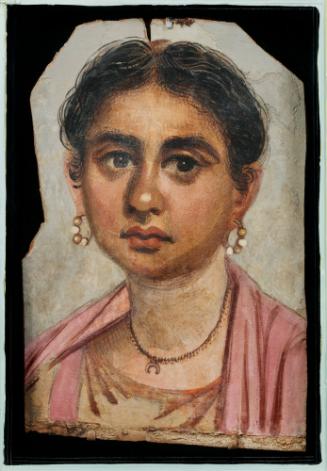
19th Century (?)

Membership
Become a TMA member today
Support TMA
Help support the TMA mission