

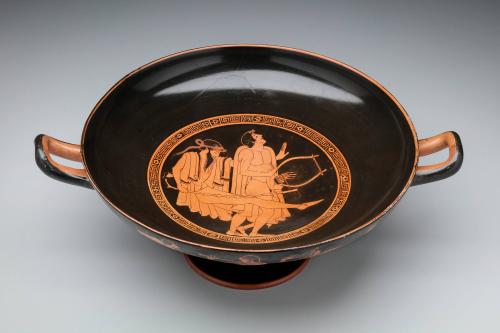
Drinking Cup (Kylix) With Drunk Revelers



Drinking Cup (Kylix) With Drunk Revelers
Artist
The Foundry Painter
(Greek)
Place of OriginGreece, Athens, reportedly found at Vulci, Italy
Dateabout 490-480 BCE
DimensionsH 5 1/8 × Rim Diam 11 1/2 × Max L 14 5/8 x Base Diam 4 7/8 in. (13 × 29.2 × 37.1 x 12.4 cm)
MediumRed Figure; Wheel-thrown, slip-decorated earthenware
ClassificationCeramics
Credit LinePurchased with funds from the Libbey Endowment, Gift of Edward Drummond Libbey
Object number
1964.126
On View
Toledo Museum of Art (2445 Monroe Street), Gallery, 02, Classic
DescriptionThis red-figure drinking cup, or kylix, features a shallow, wide bowl supported by a slender stem and a circular foot. Two horizontal handles curve upward from the sides of the bowl. The interior circular field, known as the tondo, contains two figures: a bearded man and a youth who holds a stringed instrument and has his mouth open as if vocalizing. The exterior of the bowl is decorated with a continuous frieze of male figures in various poses of movement. Some figures are draped in cloaks while others are nude. They carry objects including walking sticks, drinking vessels, and musical instruments like the double-flute and castanets. Fine, straight lines of added red pigment extend from the mouth of one figure on Side B toward the ground. Fragmentary inscriptions composed of Greek letters are scattered in the background of both the interior and exterior scenes.
Label TextThe scenes on this cup show revelers (komasts) at the end of a symposium or party. A symposium was an important social activity in ancient Athens and participation was limited to aristocratic males. Wine was mixed with water in a vessel called a krater to a strength determined by the host of the symposium. Besides drinking, poetry was sung, games were played, political alliances were formed, and personal relationships started. After several kraters of wine, the end of the party was marked with a rowdy parade (called a komos) through the streets. The Foundry Painter, the anonymous Athenian artist who painted this cup, was given his modern name from an important kylix painted by him, today in Berlin, which shows workers in a foundry casting bronze statues.Published ReferencesVermule, Emily, "Myths, Shapes and Colors," Apollo, vol. 86, no. 70, 1967, p. 427, figs. 13, 14.
"Accessions of American and Canadian Museums," Art Quarterly, vol. 30, no. 2, 1967, p. 153.
Riefstahl, Rudolph M., "Greek Vases," Toledo Museum of Art Museum News, vol. 11, no. 2, 1968, p. 41.
Beazley, John D., Paralipomena, Oxford, 1971, p. 370, no. 12 bis.
Beazley, John D., "Un Realista Greco," Accademeia nazionale dei Lincei, Rome. Fondazione Antonio Feltrinelli Adunanze straordinarie per il conferimento dei premi della fondazione A. Feltunelle, I;3 (1966), pp. 53-60.
Boulter, Cedric G., and Kurt T. Luckner, Corpus vasorum antiquorum: Toledo Museum of Art, U.S.A. Fasc. 17, Toledo, 1976, p. 35, repr. pl. 55 and 56, fig. 10-12.
Gorney, Michaelene, "Musical instruments: strings," Toledo Museum of Art Museum News, vol. 20, no. 4, 1978, p. 91, repr. fig. 1.
Keuls, Eva C., The reign of the phallus: sexual politics in ancient Athens, New York, 1985, p. 70, fig. 51.
Maas, Martha and Jane McIntosh Snyder, Stringed instruments of ancient Greece, New Haven, 1989, pp. 93, 96, 98, 115, 122, 123, 124, 125, 126, repr. p. 110, 130.
Bundrick, Sheramy D., Music and dance in classical Athens, Cambridge, Eng., Cambridge, 2005, p. 22, 84, 205, n. 34, 216, n. 167, fig. 11 (exterior), p. 23, fig. 52 (interior), p. 23, fig. 52, (interior), p. 85.
Yatromanolakis, Dimitrios, Sappho in the making: the early reception, Cambridge, MA, Center for Hellenic Studies, 2007, p. 119-20, fig. 12, p. 121.
Lear, Andrew and Eva Cantarella, Images of ancient Greek pederasty: boys were their gods, London, Routledge, 2008, p. 115, fig. 3.7, p. 117.
Dercy, Benoit, Le Travail des Peaux et du cuir Dans le Monde Grec Antique, Naples, Centre Jean Berard, 2015, p. 131, repr. (col.) fig. 26, p. 133.
Cosgrove, Charles H., Music at Social Meals in Greek and Roman Antiquity, New York, Cambridge University Press, 2023, p. 71, repr. fig. 2.1, p. 72.
Exhibition HistoryChicago, Art Institute, Greek Vase-Painting in Midwestern Collections, 1979-1980, no. 101, p. 178-179, repr.Toledo Museum of Art, Out of Sight, June 18-Aug. 29, 2010 (no cat.).
Toledo Museum of Art, The Berlin Painter and His World: Athenian Vase Painting in the Early Fifth Century BC, July 8-October 1, 2017.
Comparative ReferencesSee also Beazley, John D., Attic Red-figure Vase-painters, Oxford, 1960, p. 400, ff.cf. Beazley, John D., Attic Red-figure Vases in American Museums, Cambridge, Mass., 1968, p. 94.


2nd-1st century BCE
Unidentified, Gorgoneion Group
about 560 BCE


Late 3rd to mid-4th century CE


1st century BCE - 4th century CE

Membership
Become a TMA member today
Support TMA
Help support the TMA mission