

Siren-Shaped Flask with Ancient Perfume Residue



Siren-Shaped Flask with Ancient Perfume Residue
Place of OriginGreece, Corinth
Dateabout 580-570 BCE
DimensionsH: 3 17/32 in. (9.0 cm); Diam (body): 2 3/16 in. (5.6 cm); L: 3 5/32 in. (8.0 cm)
MediumMolded earthenware with slip decoration
ClassificationCeramics
Credit LinePurchased with funds from the Libbey Endowment, Gift of Edward Drummond Libbey
Object number
1967.133
Not on View
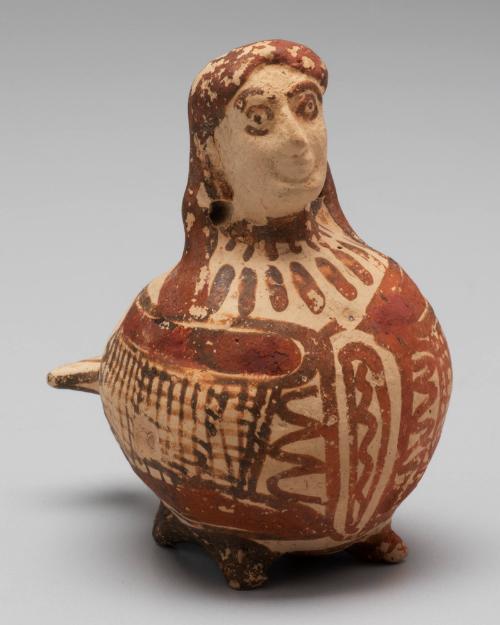
DescriptionThis small ceramic vessel is molded in the shape of a siren, a mythological creature with the head of a woman and the body of a bird. The figure stands on two short legs and a tail that projects backward to form a tripod base. The human head faces forward with large eyes and long hair that falls over the shoulders. The bird body is globular and rounded, maintaining the volume of a standard aryballos. A spout for filling and pouring liquid is located on the top of the siren's head.
Label TextThis small vessel, known as an aryballos, was designed to hold scented oil or perfume. It is shaped like a siren, a mythological creature with a woman’s head and a bird’s body. In Greek mythology, sirens were often associated with the dangerous allure of the sea, but in Corinthian art, they were also popular decorative motifs. This specific vase is a rare example that has preserved traces of its original contents. Scientific testing revealed that it once held an oil scented with pungent resins from pine, fir, or cypress trees, sealed inside by a plug of earth. Such oils were likely used for personal grooming, insect repellent, or burial rituals.
Significantly, this vessel was the subject of organic residue analysis published in 1994 by William R. Biers. Gas chromatography-mass spectrometry (GC-MS) of the contents revealed cholesterol and terpenoids (abietic acid, manoyl oxide), indicating the vessel originally contained an animal-fat-based or oil-based unguent scented with coniferous resins (Pinaceae family). The presence of a soil plug sealed within the vessel suggests the vase may have been deposited in a tomb while still containing its valuable oil.
Published ReferencesMünzen und Medaillen Auktion 34, Basel, 6. Mai 1967, p. 50 and pl. 26, lot no. 105.Riefstahl. R.M., "Greek Vases," Toledo Museum of Art Museum News, vol. 11, no. 2, 1968, p. 30, repr.
Bloesch, H. ed., Das Tier in der Antike, Zurich, Archäologisches Institut der Universität, Sept. 21 to Nov. 17, 1974, p. 44 f and pl. 45, no. 266.
Boulter, Cedric G., and Kurt T. Luckner, Corpus Vasorum Antiquorum, Toledo Museum of Art, fasc. 2, U.S.A. fasc 20, Mainz, 1984, pl. 76, nos. 1-5.
Amyx, Darrell A., Corinthian vase-painting of the archaic period, Berkeley, 1988, p. 528, n. 353.
Biers, William R. and others, Lost Scents: Investigations of Corinthian "Plastic" Vases by Gas Chromatography-Mass Spectrometry, (MASCA Research Paper in Science and Archaeology, vol. 11, 1994), Philadelphia, 1994, p. 11, 24, 26-27, 48-49.
Lexicon iconographicum mythologiae classicae, (LIMC), Zürich, 1981-1999, vol. VIII, p. 1095, no. 17b.
Comparative ReferencesSee also Ducat, J. "Les vases plastiques corinthiens," Bulletin de Correspondence Hellenique, vol. 87, 1963, pp. 431-458.cf. Baur, P.V.C., Catalogue of the Rebecca Darlington Stoddard Collection of Greek and Italian Vases in Yale University, New Haven, 1922, p. 64f, no. 92, figs. 15-16.
cf. Wallenstein, Korinthische Plastik des 7, und 6. Jhdts. v. Chr, Bonn, 1971, p. 132 and pl. 14, 3-4 (for a siren vase with a four-spoke pattern on loan to the Antikenmuseum, Basel)

about 480 BCE
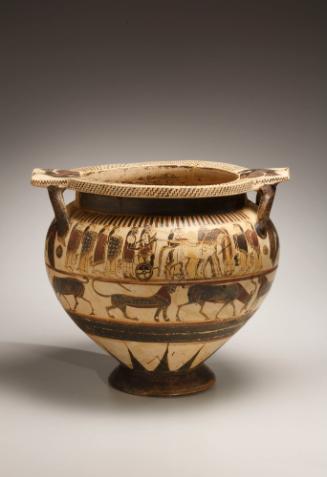
Unidentified, Gorgoneion Group
about 560 BCE


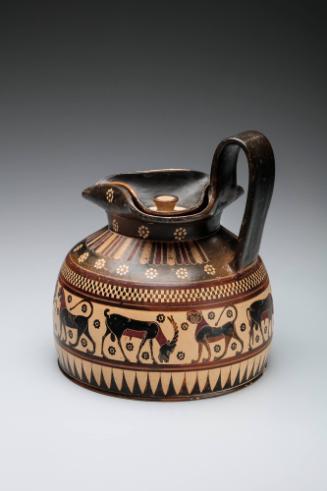

Late 19th century
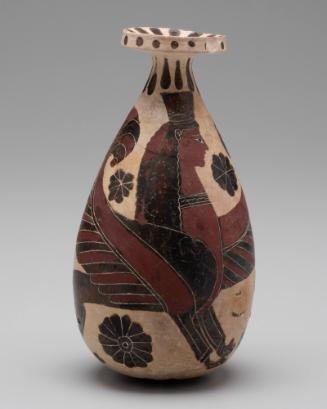
A painter near the Double-bodied Sphinx Painter
about 625 BCE

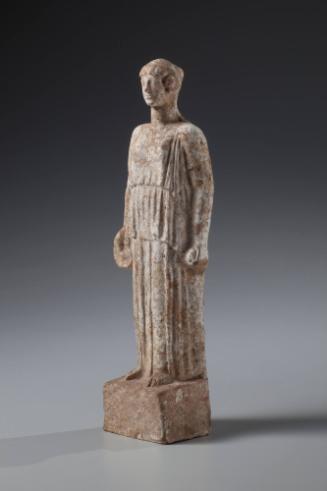
mid-5th century BCE

about 300 BCE

1st century BCE - 3rd century CE

Membership
Become a TMA member today
Support TMA
Help support the TMA mission