

Pectoral Crucifix
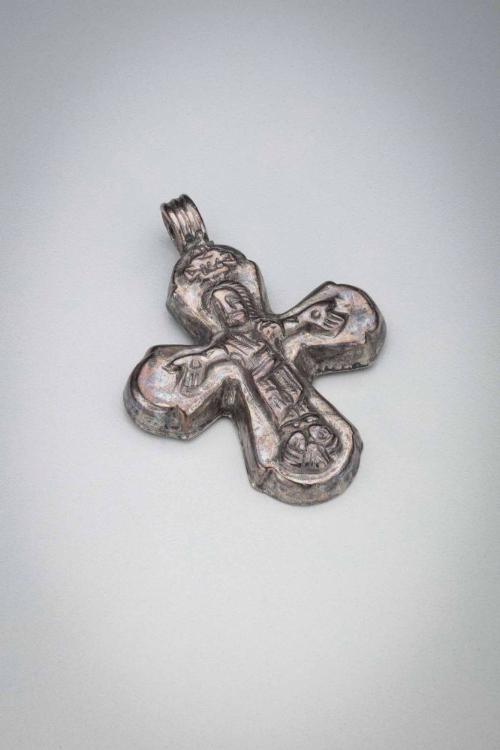

Pectoral Crucifix
Period
Byzantine Empire
(Byzantine, 395 CE-1453 CE)
Place of OriginByzantine Empire, likely Syria or Palestine
Date6th century
Dimensions2 1/8 × 1 5/8 × 3/8 in. (5.4 × 4.1 × 1 cm)
MediumSilver (repoussé)
ClassificationMetalwork
Credit LinePurchased with funds from the Libbey Endowment, Gift of Edward Drummond Libbey
Object number
1959.126
Not on View
DescriptionA silver pectoral cross formed from two sheets of metal joined at the edges, featuring a cylindrical suspension loop at the top. The obverse displays a high-relief repoussé figure of Christ crucified. Christ is depicted as bearded and wearing a long tunic (colobium) that reaches his ankles. His arms are spread horizontally, and his feet are supported by a suppedaneum (footrest). Above the head of Christ is a tabula ansata inscribed with the Greek letters "XC" (Christos). The reverse is undecorated but features a circular aperture at the center, likely for the insertion or viewing of a relic.
Exhibition HistoryThe Dayton Art Institute, The Roman World: Religions and Everyday Life (featuring the Brooklyn Museum exhibition: Tree of Paradise: Jewish Mosaics from the Roman Empire), September 21, 2007 - January 6, 2008 (no catalogue).


about 1500


about 1513-1521

2nd - 1st century BCE


Membership
Become a TMA member today
Support TMA
Help support the TMA mission