

Striped Mosaic Glass Bowl with Reticella Rim

Striped Mosaic Glass Bowl with Reticella Rim
Place of OriginItaly
DateLate 1st century BCE - Early 1st century CE
Dimensionsrim diam: 3 3/8 in. (8.4 cm)
Mediummulti-colored glass
ClassificationGlass
Credit LinePurchased with funds from the Libbey Endowment, Gift of Edward Drummond Libbey
Object number
1968.87
Not on View
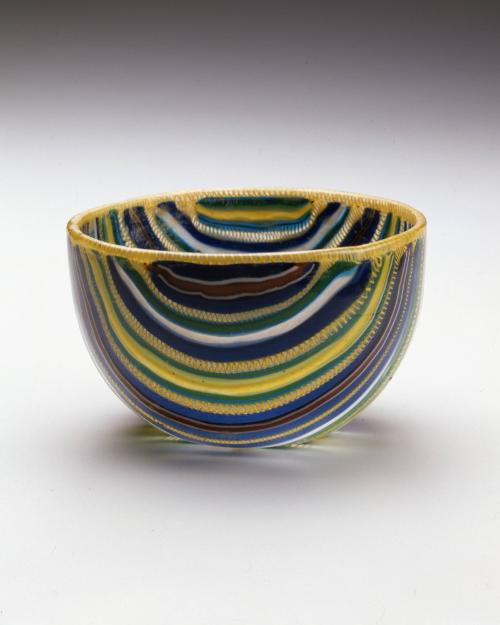
DescriptionA hemispherical bowl with a vertical rim, rounded edge, and slightly concave bottom, formed using the mosaic (ribbon) glass technique. The vessel is composed of tripartite composite glass canes laid side-by-side in parallel rows, separated by single lengths of colorless and white network (reticella) canes. The polychrome pattern repeats the following sequence: a composite cane of opaque yellow encased in colorless glass flanked by green strips; a composite cane of opaque white encased in colorless glass flanked by a green strip (right) and blue strip (left); and a composite cane of opaque red encased in colorless glass flanked by dark blue strips. A colorless network cane wound spirally with two opaque yellow threads forms the rim. The vessel was assembled from lengths of cane, fused into a disk, and sagged over a convex mold. The interior is fire-polished; the exterior is rotary-polished.
Label TextThis hemispherical bowl represents the height of the polychrome mosaic glass industry in the Late Hellenistic and Early Roman periods. Often referred to as "ribbon glass," this type of vessel was manufactured by arranging pre-formed lengths of composite canes in a parallel sequence. In this example, the artisan utilized a sophisticated palette of opaque yellow, white, and red encased in translucent green, blue, and colorless glass. These broad bands are visually separated by delicate reticella (network) canes—twisted threads of opaque yellow and colorless glass—which add texture and complexity to the design. A matching reticella cane was applied as a rim wrap, a characteristic finish for high-quality wares of this period. The bowl’s provenance is notable, having originated in the collection of Giorgio Sangiorgi (Rome), one of the most significant assemblers of ancient glass in the early 20th century.Published ReferencesThe Toledo Museum of Art, Art in Glass: A Guide to the Glass Collections, Toledo, Ohio, 1969, pp. 12-13, ill.;
Grose, David F., "Ancient Glass," Toledo Museum of Art Museum News 20, 1978, p. 76, fig. 11;
Grose, David F., "The Formation of the Roman Glass Industry," Archaeology 36, no. 4, 1983, pp. 40-43;
Grose, David F., "The Origins and Early History of Glass," in The History of Glass, eds., Dan Klein and Ward Lloyd, 1984a, pp. 23-24, ill.;
Grose, David F., "Innovation and change in ancient technologies: The anomalous case of the Roman glass industry," in High-technology ceramics, Westerville, OH, 1986, p. 71, pl. III (col.), fig. 9, p. 72.
Grose, David F., Early Ancient Glass: Core-formed, Rod-Formed, and Cast Vessels and Objects from the Late Bronze Age to the Early Roman Empire, 1600 B.c. to A.d. 50, New York, Hudson Hills Press in association with the Toledo Museum of Art, 1989, Catalog No. 339, p. 289, repr. (col.) p. 220, drawing, p. 418.
Page, Jutta-Annette, The Art of Glass: Toledo Museum of Art, Toledo, Ohio, Toledo Museum of Art, 2006, p. 29, repr. (col.) p. 28.
Putney, Richard H. and Paula Reich, Glass in Glass: Toledo Museum of Art, Toledo, 2007, repr. (col.) p. 13, (det.) p. 12.
Toledo Museum of Art, Toledo Museum of Art Masterworks, Toledo, 2009, p. 80, repr. (col.).
Lierke, Rosemarie, Die nicht-geblasenen antiken Glasgefaesse, Offenbach/Main, Deutsche glastechnische Gesellschaft, 2009, p. 41, repr. (col.).
Exhibition HistoryPhiladelphia, The University Museum, University of Pennsylvania, 1995.
about 1875-1880
Late 1st century BCE to early 1st century CE
Late 1st century BCE to early 1st century CE
Late 1st century BCE to early 1st century CE
Late 1st century BCE to early 1st century CE
Late 1st century BCE to early 1st century CE
Early to mid-1st century CE
Late 1st century BCE to early 1st century CE
Late 1st century BCE to early 1st century CE
Late 1st century BCE to early 1st century CE

Late 1st century BCE to early 1st century CE
Late 1st century BCE to early 1st century CE
Membership
Become a TMA member today
Support TMA
Help support the TMA mission