

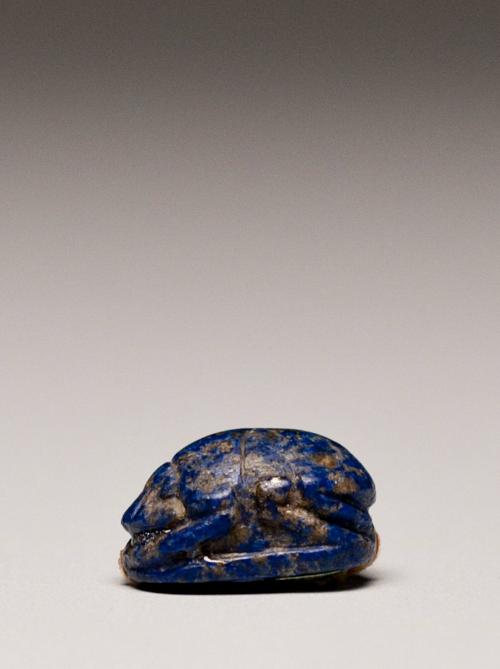
Lapis Lazuli Scarab Inscribed for Ramses II


Lapis Lazuli Scarab Inscribed for Ramses II
Place of OriginEgypt
Date19th Dynasty (1292–1189 BCE)
DimensionsH: 3/4 in. (1.9 cm); W: 9/16 in. (1.4 cm); Depth: 7/16 in. (1.1 cm)
MediumLapis lazuli
ClassificationJewelry
Credit LineGift of Henry W. Wilhelm
Object number
1927.70
Not on View
DescriptionThe object is a scarab beetle carved from dark blue lapis lazuli featuring mottled impurities. The back of the beetle is well-modeled with a high profile and a shaped prothorax distinguished from the elytra (wing cases) by a single incised line. The head features prominent eyes and the legs are carved in relief against the side of the body without striations. The base is incised with the prenomen of the king: Wsr-m3't-R' Stp-n-R' (Usermaatre-Setepenre). The inscription is not enclosed in a cartouche and reads from right to left. The object is pierced lengthwise for suspension.
Label TextRamses II (reigned 1279–1213 BCE), known as Ramses the Great, is often celebrated as the most powerful pharaoh of the New Kingdom. His sixty-six-year rule was marked by monumental building projects, such as Abu Simbel, and military campaigns in the Levant. This scarab functions as a seal and features his throne name, Usermaatre-Setepenre ("Mighty is the Truth of Re, Chosen of Re"). Such objects are among the most numerous surviving from ancient Egypt, attesting to the extraordinary length and prosperity of his reign.
The amulet is carved from lapis lazuli (khesbed), a semi-precious stone prized for its deep blue color flecked with golden pyrite. Associated with the night sky and the hair of the gods, this material was not native to Egypt but imported via long-distance trade from modern-day Afghanistan. Its foreign origin and expense meant it was restricted to royal and high-elite use.
This object was acquired through Dr. Caroline Ransom Williams (1872–1952). The first American woman professionally trained as an Egyptologist, she served as a pivotal consultant for the Toledo Museum of Art and was instrumental in building its early Egyptian collection.

Early Dynastic Period II-III, about 2600 BCE

16th century


about 2300 BCE
about 1865

18th Dynasty (1550-1292 BCE), about 1381 BCE

Covered Cup of Lapis Lazuli (Salière en Lapis-Lazuli), From "Gemmes et Joyaux de la Couronne" pl. 28
Jules Ferdinand Jacquemart
1864, published 1868
26th Dynasty (664–525 BCE), about 600 BCE
about 1450

Membership
Become a TMA member today
Support TMA
Help support the TMA mission