

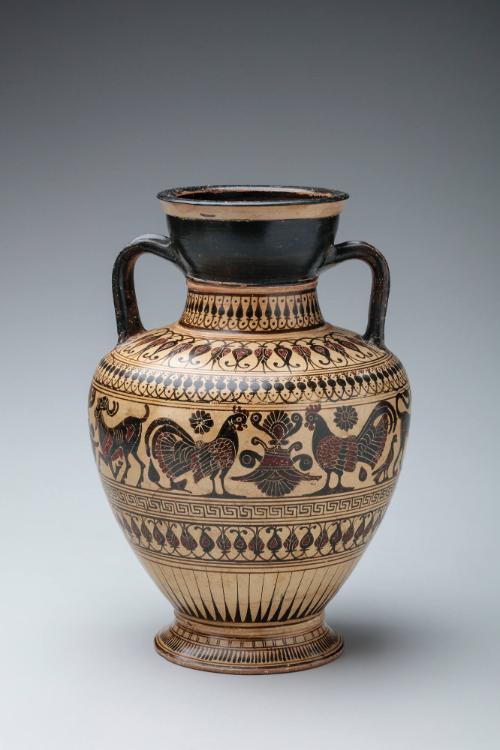
Laconian Amphora with Sphinxes, Lions, and Cocks



Laconian Amphora with Sphinxes, Lions, and Cocks
Artist
The Naukratis Painter
(Greek)
Place of OriginGreece, Laconia, reportedly from Vulci, Italy
Dateabout 560 BCE
DimensionsH: 10 29/32 in. (27.7 cm); Diam (rim): 4 17/32 in. (11.5 cm); Max Diam (body): 7 19/32 in. (19.3 cm); Diam (foot): 4 9/16 in. (11.6 cm)
MediumWheel-thrown, slip-decorated earthenware with incised details
ClassificationCeramics
Credit LinePurchased with funds from the Libbey Endowment, Gift of Edward Drummond Libbey
Object number
1964.53
On View
Toledo Museum of Art (2445 Monroe Street), Gallery, 02, Classic
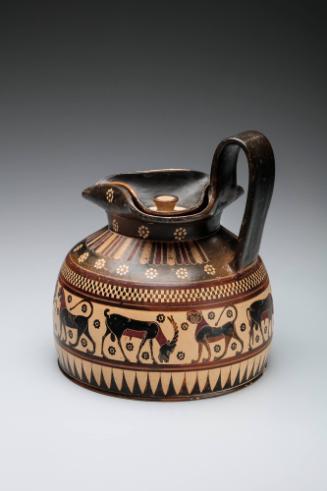
DescriptionA complete, wheel-thrown ceramic amphora with a black slip-coated neck and foot. The shoulder features a decorative frieze of alternating lotus buds and palmettes. The main body register displays a black-figure animal frieze containing sphinxes flanking a central floral motif, roosters (cocks), and lions, all detailed with incision. Below the main frieze are subsidiary bands featuring a geometric meander pattern and a chain of pomegranates. The lower body features a band of rays rising from the foot. The interior of the mouth is slip-coated.
Label TextThis amphora is a unique example of Laconian ceramic production, being the only surviving complete amphora with figure decoration from this region.
Made in Laconia (the region controlled by Sparta) around 560 BCE, it was painted by an artist scholars call the "Naukratis Painter." While Sparta is often remembered for its military austerity, this vase reveals a different side of the culture: a love for precise, disciplined beauty and exotic imagery. The orderly rows of animals—sphinxes, lions, roosters, and goats—imitate the "animal style" popular in the cosmopolitan trading city of Corinth. The sharp edges of the rim and foot suggest the potter was trying to mimic the crisp forms of expensive metal vessels. According to dealer Nicolas Koutoulakis, the Laconian amphora was found in the Etruscan city of Vulci (Italy).
Published References"Accessions of American and Canadian Museums," Art Quarterly, vol. 29, nos. 3-4, 1966, p. 289, repr. p. 291.Vermeule, Emily, "Myths, Shapes and Colors," Apollo, vol. 86, no. 70, Dec. 1967, p. 420, 421, fig. 4.
Riefstahl, Rudolph M., "Greek Vases," Toledo Museum of Art Museum News, vol. 11, no. 2, 1968, repr. p. 31.
A Guide to the Collections, Toledo Museum of Art, 1966, repr. p. [8].
Luckner, Kurt T., "Greek Vases: Shapes and Urns," Toledo Museum of Art Museum News, vol. 15, no. 31, 1972, p. 64, fig. 4.
Stibbe, Conrad M., Lakonische Vasenmaler, Amsterdam, 1972, pp. 64 (Group F), 78-79, 271, no. 41, pl. 22, 1-4.
Boulter, Cedric G., and Kurt T. Luckner, Corpus Vasorum Antiquorum, Toledo Museum of Art fasc. 2, U.S.A. fasc. 20, Mainz, 1984, pl. 80.
Toledo Museum of Art, Toledo Treasures, Toledo, 1995, p. 40, repr. (col.).
Boardman, John, Early Greek vase painting, London, 1998, p. 187, fig. 412, p. 205.
Stibbe, Conrad M., Laconian Oil Flasks and Other Closed Shapes, Amsterdam, Allard Pierson Museum, 2000, no. B1, fig. 140.
Görkay, Kutalmış, “A Laconian Cup from Daskyleion,” in Cevdet Bayburtluoğlu İçin Yazılar – Essays in Honour of Cevdet Bayburtluoğlu, ed. Coşkun Özgünel, Orhan Bingöl, Vedat İdil, Seyhan Doruk, Kutalmış Görkay & Musa Kadıoğlu, Istanbul, Homer Kitabevi, 2001, p. 106.
Popkin, Maggie L., “Roosters, Columns, and Athena on Early Panathenaic Prize Amphoras: Symbols of a New Athenian Identity,” Hesperia, vol. 81, no. 2, April–June 2012, p. 218.
Exhibition History"Treasures for Toledo," Toledo Museum of Art, 1964.
Unidentified, Gorgoneion Group
about 560 BCE





1650-1700

Membership
Become a TMA member today
Support TMA
Help support the TMA mission