

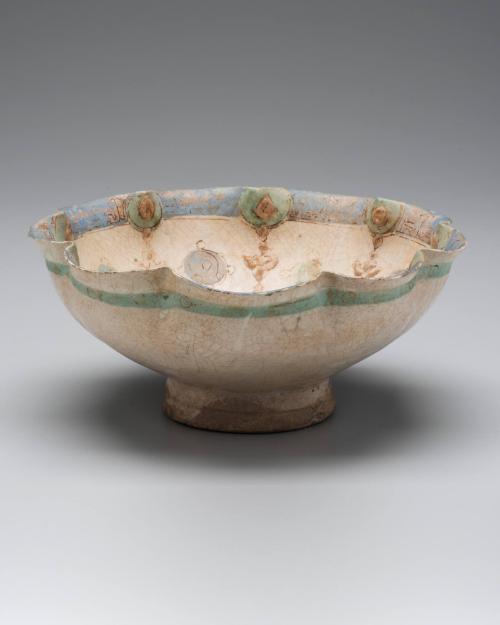
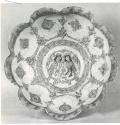
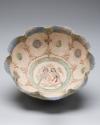
Lobed Bowl with Harpies

Lobed Bowl with Harpies
Period
Seljuq Period
(1037 - 1194)
Place of OriginIran, probably Ray or Kashan
DateLate 12th-early 13th century
DimensionsHeight: 3 3/4 in. (9.5 cm)
Rim (Diameter): 8 7/8 in. (22.5 cm)
Base (Diameter): 3 3/8 in. (8.6 cm)
Rim (Diameter): 8 7/8 in. (22.5 cm)
Base (Diameter): 3 3/8 in. (8.6 cm)
MediumGlazed stonepaste with enamel decoration.
ClassificationCeramics
Credit LinePurchased with funds from the Libbey Endowment, Gift of Edward Drummond Libbey
Object number
1941.19
Not on View
DescriptionA thinly potted lobed bowl with a ridged foot and rim. Decorated in haft rang, seven-color polychrome technique. In the bottom of the bowl, two harpies in an elaborate roundel; around them in the cavetto an elaborate gold and turquoise festoon in low relief. Outside is undecorated except for a pale turquoise band with gilded circles.
Label TextThe lobed form of this bowl is also found in Islamic metalwork and glass. Two harpies, mythical birdwomen, appear at the center of the bowl.Exhibition HistoryLondon, Royal Academy, International Exhibition of Persian Art, London, 1931, #180 P.
Ann Arbor, University of Michigan Museum of Art, Persian Art Before and After the Mongol Conquest, 1959, no. 80.

13th century

1100-1299
12th century

1860-1890
New Kingdom Period
18th Dynasty (1550-1292 BCE), about 1350 BCE
Membership
Become a TMA member today
Support TMA
Help support the TMA mission