

Elongated Cylindrical Bottle with Two Handles


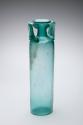


Elongated Cylindrical Bottle with Two Handles
Place of OriginIsrael, reportedly from Mount Carmel
Dateabout 3rd century
DimensionsH: 15 in.; W: 4 1/4 in.; D: 4 1/4 in. Rim Diam: 2 7/8 in.; Diam: 3 1/2 in. Handle H: 3 in.
MediumMold-blown glass with applied handles
ClassificationGlass
Credit LineGift of Edward Drummond Libbey
Object number
1916.77
On View
Toledo Museum of Art (2445 Monroe Street), Gallery, 02, Classic
DescriptionTranslucent to transparent natural grayish green (5 G 5/2) glass with two similarly colored handles. Thick glass with pinprick and vertically elongated bubbles in the body and one large elongated bubble in the rim. The body was blown into a one-part mold. There is no pontil mark. Excess glass at the tips of the handles is folded against the neck.
The rim is slightly flared, rounded, and thickened in the flame, with a tool mark along the interior edge. The cylindrical neck has concave sides and leads to a sloping shoulder. The tall cylindrical body has straight sides. The flat base features an unintentional concavity on one side. Two broad pre-formed handles with fine vertical ribs extend from the shoulder to just below the rim.
Label TextThe bottle was acquired in 1916 from Azeez Khayat, a prominent dealer in ancient glass. Khayat reported that the piece was excavated by his team on his property at Mt. Carmel (modern Israel). While many of Khayat's provenance claims were generalized to "Syria," his specific mention of his own excavation team and land in a private letter to Director George W. Stevens adds a layer of potential specificity to this attribution.Published ReferencesGrose, David, "Ancient Glass," Toledo Museum of Art Museum News, vol. 20, no. 3, 1978, p. 81, repr. fig. 17.
Grose, David, "The Origins and Early History of Glass," in The History of Glass, London, 1984, repr. p. 31.
Groffi, T., and J. Heus, Beschavingen 2, Antwerp, 1990, repr. p. 241.
Cummings, Keith, A History of Glassforming, London, 2002, p. 80, repr.
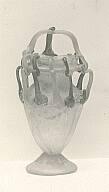
Probably mid-5th to mid-6th century
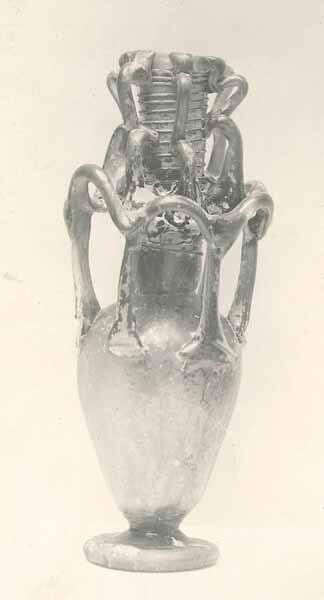
3rd-5th century CE
Probably 4th century
Second half of 1st century CE

3rd-4th century CE
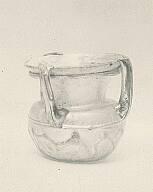
Late 4th to late 5th century
Late 6th through 5th century BCE
Possibly late 19th or early 20th century
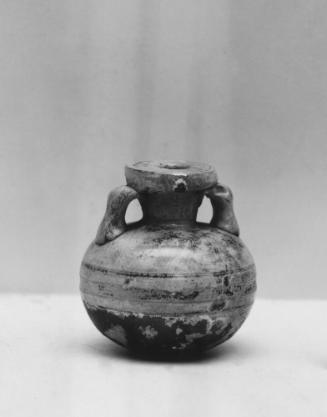
about 1st-2nd Century

about 4th century CE

Membership
Become a TMA member today
Support TMA
Help support the TMA mission